Abdominal muscles: transverse, obliques, rectus abdominis - Anatomy
Discover the abdominal muscles, their anatomy, the role of the obliques and the transverse, exercises for the lower abdomen, and advice adapted to women, men and pregnancy.
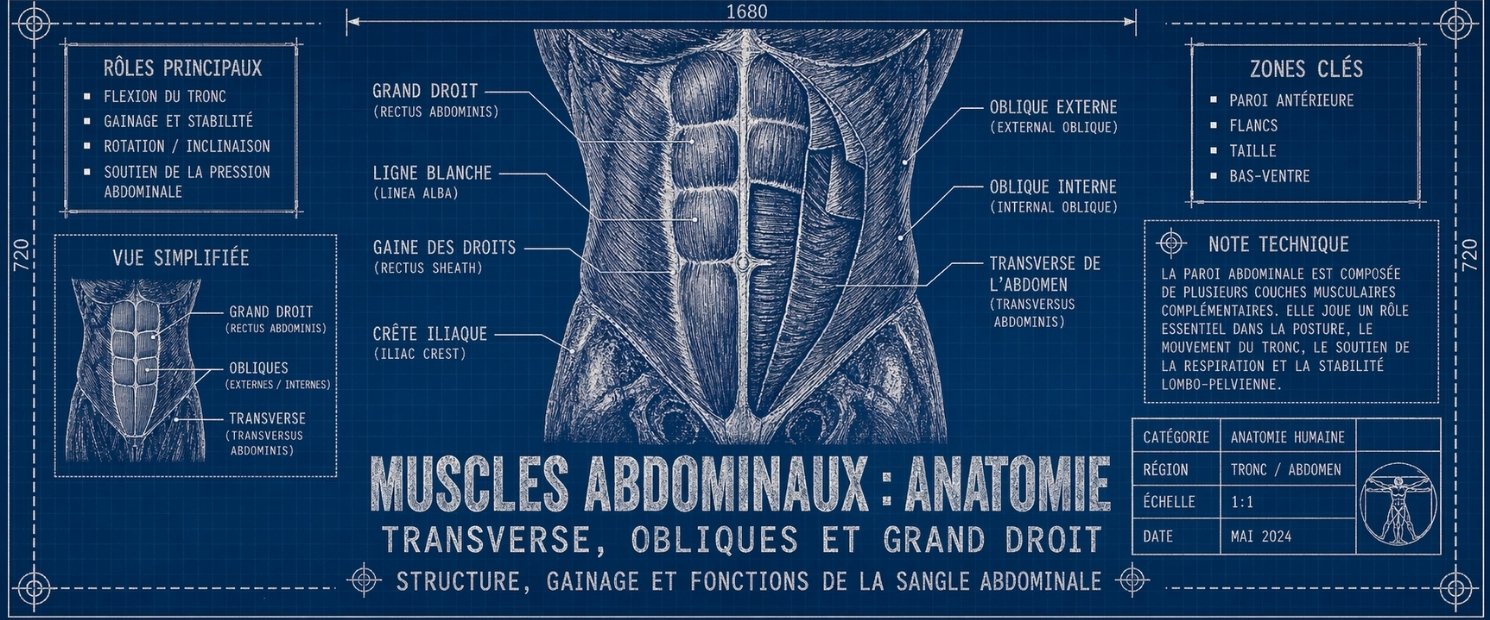
Abdominal Muscles: Understand their role before wanting to strengthen them
The abdominal muscles play a much broader role than aesthetics. They participate in posture, breathing, trunk stability, the transfer of force between the upper and lower body, as well as the protection of the organs. When we talk about abs, many people immediately think of the “six pack”. However, the abdominal strap is more complex. It includes several layers, several fiber directions and several complementary functions.
To progress intelligently, you must know the major muscle families. We find the anterolateral abdominal muscles, the deep structures, the muscles of the lower abdomen and the lateral muscles. This anatomical reading allows us to better understand why certain exercises target stability more, while others require more rotation, flexion or core.
Search searches such as abdominal muscles anatomy, staps or even “abdominal anatomy” often reflect a simple need: to know what we are really working on. In practice, this understanding improves the quality of execution and limits frequent errors.
Abdominal Muscles Anatomy: superficial and deep layers
When we approach the abdominal muscles anatomy, we must distinguish between the visible layers and the deep layers. The rectus abdominis is the best known. It extends to the front of the trunk and participates in the flexion of the bust. Alongside it, the lateral and deep muscles play an essential role in rotation, stabilization and maintaining abdominal pressure. The large lateral structures include the external and internal obliques, while the transverse is deeper. :contentReference[oaicite:1]{index=1}
This organization explains why a toned stomach does not rely solely on crunches. A balanced abdominal strap requires coordinated work of the rectus abdominis, obliques and deep muscles. This is particularly true for people who want to improve their posture, protect their back or regain better control of the center of the body.
Lateral abdominal muscles and oblique muscles
The lateral abdominal muscles mainly correspond to the obliques and associated structures on the sides of the trunk. If you type lateral abdominal muscles 8 letters, you often come across “obliques”, which reflects their importance in the rotation and inclination of the torso. We also find formulations like lateral ab muscles, lateral abdominal muscles, oblique ab muscles and oblique abdominal muscles.
These muscles are essential for stabilizing the pelvis, transmitting force during movements and supporting the waist. This is why many seek to build lateral abs or build oblique abs. Well-constructed work on the obliques improves core tone, coordination and control of movement.
Internal oblique abdominal muscle: a key player in rotation
The internal oblique abdominal muscle is located below the external oblique. It participates in rotation, inclination and stabilization of the trunk. In practice, it is used in numerous lateral core exercises, controlled rotation and unilateral work. This relative depth explains why a simple quick movement is not always enough to recruit it well.
The oblique abdominal muscles must therefore remain precise. Aller trop vite ou charger excessivement peut déplacer le travail vers les fléchisseurs de hanche ou la nuque. Better to focus on quality of execution, breathing and pelvic control.
Deep Abdominal Muscles and Transverse Abdominal Muscles
The deep abdominal muscles are often less visible, but they are fundamental. They participate in maintaining the trunk, providing lumbar support and controlling intra-abdominal pressure. The main deep muscle highlighted in stability work is the transverse.
Search searches like transverse abdominal muscles, transverse abdominal muscles, transverse abdominal muscles exercises, deep abdominal muscles anatomy, strengthening deep abdominal muscles, working deep abdominal muscles, deep ab muscle strengthening, deep abdominal exercises and exercise to strengthen deep abs clearly show the growing interest in this area.
The transverse acts like a natural corset. It surrounds the trunk and contributes to stability. Medical sources also describe the transversus abdominis as the deepest of the lateral muscles of the abdominal wall. :contentReference[oaicite:2]{index=2}
How to strengthen the transverse abdominal muscles in women
strengthening the transverse abdominal muscles in women generally involves core exercises, breathing and control of the center of the body. Les mouvements lents, précis et bien respirés sont souvent plus utiles que les répétitions rapides. Quadrupedal variations, controlled expirations, adapted cores and certain Pilates-inspired exercises are often very relevant.
This work is of particular interest to women who want a more toned stomach without overloading the spine or doing only flexion movements. It can also complete an objective of postural maintenance, return to sport or overall stability.
Women's Abdominal Muscles: objectives, sensations and adaptation according to age
Research around women's abdominal muscles, women's stomach muscles, women's abdomen muscles, women's stomach muscles, women's abdominal muscles and women's abdominal muscles show that expectations are varied. Some women want to tone their stomach. Others want to find a more stable center of the body. Still others are looking for exercises adapted to their age or physical situation.
build stomach for 40 year old women, build stomach for 50 year old woman and build stomach for 60 year old woman do not have exactly the same needs. With age, abdominal work must often include more mobility, posture, breathing, progression and prevention of lower back pain. This doesn't mean you should train less. Cela signifie surtout qu’il faut s’entraîner plus intelligemment.
Abdominal exercises for women according to level and age
The queries abdominal exercises for women, abdomen exercise for women, abdomen exercise for women 50 years old, abdomen exercises for women 60 years old, abdominal exercises for women 55 years old, abdominal exercises for women 60 years old, abdominal exercises for women 50 years old and exercises abs for 70 year old womenshow that a single approach is not enough.
For many women, the most interesting exercises are those that combine breathing, core, pelvic control and smooth movement. The modified core, the dead bug, some standing variations, the adapted plank or stability exercises on the back with bent knees can be very useful.
The woman's belly workout benefits from remaining progressive. The goal is not to seek the burn at all costs, but to create tone, stability and a better connection with the abdominal strap.
Muscle stomach woman pain and caution
A feeling of normal muscle fatigue after exercise does not have the same meaning as real pain. Searches like muscle belly pain for women and muscle abdominal pain for women should be approached with caution. Persistent, sharp, increasing or unusual pain merits professional evaluation, especially if it interferes with breathing, walking or daily movements.
Abdominal Muscles Pregnant Woman: what you need to understand
The searches for abdominal muscles for pregnant women, abdominal muscles for pregnant women, abdomen muscles for pregnant women and abdominal exercise for pregnant women are very common, because pregnancy naturally modifies the abdominal wall. As the uterus grows, the tissues stretch and the mechanical organization of the trunk changes. NHS hospital sources point out that the abdominal muscles stretch during pregnancy and that working the deep muscles can help with support, while certain exercises such as sit-ups are not recommended in some contexts. :contentReference[oaicite:3]{index=3}
In an uncomplicated pregnancy, exercise is generally encouraged, with adaptation and caution. ACOG and the NHS remind us that physical activity can be beneficial during pregnancy, provided it is adjusted and comfortable. :contentReference[oaicite:4]{index=4}
Abdominal exercise for pregnant women: what type of approach?
abdominal exercise for pregnant women should focus on control, breathing, alignment and comfort. Gentle deep muscle exercises, certain positions on all fours, very suitable core training and pelvic floor work may be more relevant than classic crunch movements.
The NHS, for example, offers exercises in the quadrupedal position to strengthen the stomach muscles and sometimes relieve the back during pregnancy. :contentReference[oaicite:5]{index=5}
Stomach muscle pain in pregnant women and muscle tear in pregnant women's stomach
muscular pain in pregnant women's stomach can correspond to a benign discomfort linked to stretching, postural change or effort, but significant or persistent abdominal pain during pregnancy should not be trivialized. NHS resources recommend seeking medical advice if you experience severe or unusual pain. :contentReference[oaicite:6]{index=6}
The query pregnant woman stomach muscle tear often reflects strong concern. Without making a diagnosis, it is prudent to remember that acute pain, unusual swelling, marked discomfort with exercise or rapid worsening require medical advice. The goal of a reinforcement article is never to replace a clinical assessment.
Men's Abdominal Muscles: training, beginner, home and after 50
Search searches related to men's abdominal muscles, men's abdominal muscles, men's abdominal muscles and men's abdominal exercise show varied intentions. Some people want a flat stomach. Others want more power. Still others are looking for an effective routine at home.
abdominal exercise for men at home, abdominal exercise for men for beginners, abdominal exercise for men without equipment and abdominal exercise for men without equipment pdf reflect this search for simplicity. Sheathing, adapted hollow hold, dead bug, slow mountain climbers and controlled knee raises can suit many profiles.
For more advanced men, men's abdominal training can incorporate more resistance, anti-rotation work and more demanding progressions. For more mature profiles, abdominal exercises for men over 50 and abdominal exercises for men over 60 often call for more intelligent work, based less on volume and more on control, regularity and recovery.
The flat stomach abs exercises for men are useful especially if they are part of a global approach: consistent diet, regular physical activity, stress management and sleep. The abs never work alone in the final visual result.
Lower Abdominal Muscles: what are we really working on?
The lower abdominal muscles is a highly sought-after subject. In everyday language, we often talk about the lower abdomen as a separate area. In reality, there is not a completely separate muscle just “down there”. What we feel like working on the lower abdomen corresponds above all to certain portions of the rectus abdominis, to control of the pelvis, to the transverse and to the overall recruitment of the abdominal strap.
This explains why the queries lower abdomen muscle building, lower abdomen ab exercise, lower abdomen ab exercises, lower abdomen bodybuilding exercise, standing lower abdomen ab exercise, lower abdomen abs exercise gym and lower abdomen abdominal exercise for men are so frequent.
Lower abdominal exercises for women
lower abdominal exercises for women, lower abdominal exercises for women and lower abdominal exercises for women aged 50 must remain adapted to the level, age and lumbar comfort. Exercises where the pelvis remains controlled are often safer and more effective than quick leg raises.
Standing variations, controlled walks with abdominal engagement, slow knee raises, dead bugs and some modified planks are often very useful. The objective is to better recruit the abdominal strap without pulling excessively on the back.
Lower abdominal muscle pain
lower abdominal muscle pain can appear after unusual effort, but it must remain transient. If the pain is severe, localized, unusual, accompanied by other symptoms or persistent, you should avoid continuing the exercises and seek professional advice. Muscular discomfort does not have the same value as sharp or deep pain.
Lateral Abs Exercises and Oblique Exercises: how to choose them correctly
Many practitioners look for lateral ab exercises or a lateral ab exercise to strengthen the sides of the trunk. Lateral sheathing, controlled rotations with elastic, unilateral carries, certain controlled flexions and anti-rotations are among the most interesting options.
To build oblique abs, it is not necessary to multiply the rapid twists. The quality of alignment, pelvic stability and respiratory control are often more determining. oblique abdominal strength training benefits from being integrated into an overall core program rather than isolated without logic.
Women's Abdominal Muscles Anatomy and Women's Stomach Muscle Anatomy
woman's abdominal muscle anatomy and woman's stomach muscle anatomy refer to an expectation of precision. The basic structure of the abdominal muscles is the same in women and men, but the hormonal context, pregnancy, the pelvic floor, postural experience and training objectives can modify the way of approaching strengthening.
For many women, abdominal work benefits from integrating breathing, pelvic stability and lumbar comfort. This approach is not “less sporting”. It is often smarter, more sustainable and more efficient in the medium term.
Strengthening the Abdominals: simple principles to progress
Whether the objective is to build lateral abs, work the obliques, strengthen the deep abdominal muscles or target the lower abdomen, a few principles remain constant. It requires controlled execution, reasonable progression, regular frequency and appropriate breathing.
- Prioritize control over speed.
- Keep a stable pelvis during exercises.
- Vary between sheathing, anti-rotation, controlled flexion and standing work.
- Adapt the difficulty to the age, level and physical context.
- Avoid force in case of unusual pain.
To go further on lateral work and the role of the obliques, you can consult our dedicated guide: Oblique muscles of the abdomen.
Conclusion: abdominal muscles are not just about visible abs
The abdominal muscles are a complex functional unit. Between the anterolateral abdominal muscles, the lateral abdominal muscles, the oblique abdominal muscles, the deep abdominal muscles, the transverse abdominal muscles, the work of the lower abdomen and the adaptations in women, men or during pregnancy, there is not a single way to train.
Good reasoning consists of starting from anatomy, the actual level, joint comfort and the desired objective. A strong stomach does not rely solely on repeating crunches. It is based on a balanced abdominal strap, well coordinated, well breathed and adapted to each profile.