

Downward facing dog: an essential posture in yoga
The downward-facing dog is one of the best-known yoga postures. We find it in beginner classes, in dynamic sessions, in fluid sequences and in gentler practices. This position has become emblematic because it combines several effects at the same time. It stretches the back of the body, strengthens the upper body, mobilizes the spine and helps build better postural awareness.
Si la posture revient autant dans les recherches, c’est parce qu’elle semble simple de loin, mais qu’elle soulève beaucoup de questions dans la pratique. Internet users want to know how to do it correctly, what its benefits are, which muscles actually work, how to adapt it when you're starting out, and what its meaning is in the world of yoga. This explains the diversity of requests around downward facing dog yoga, downward facing dog benefits, downward facing dog muscles used, downward facing dog yoga how to do or even downward facing dog variation.
The great advantage of this posture is that it is not just a stretch. It is also an active, structuring and educational posture. She learns to push with the hands, to lengthen the spine, to engage the shoulders and to better distribute the weight throughout the body. Well practiced, it becomes a very complete tool for progression.
Downward facing dog yoga: what exactly are we talking about?
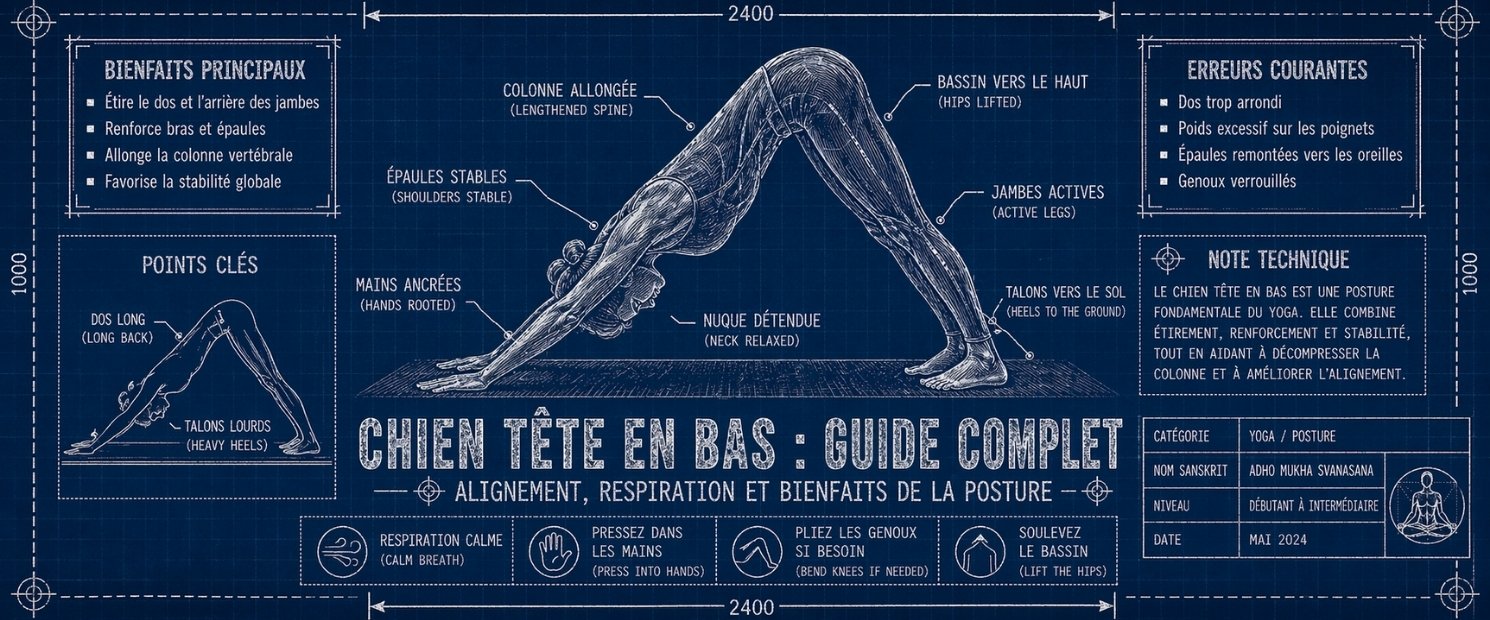
The downward facing dog yoga is a partial inverted posture in which the pelvis rises towards the sky, the hands push into the ground and the feet support themselves behind. The body then draws an inverted V shape. The head remains relaxed between the arms, without trying to look ahead. The arms and legs support the posture, while the spine lengthens.
In modern yoga practice, this posture is often used as a transitional, active recovery or strengthening position. It is found in sun salutations, in vinyasa sequences and in many postural yoga methods. It can be held for a few breaths or much longer depending on the context.
Downward facing dog yoga sanskrit
La recherche chien tete en bas yoga sanskrit est très fréquente. Le nom sanskrit du chien tête en bas est Adho Mukha Svanasana. This name is usually translated as downward facing dog or downward facing dog. In modern yoga literature, it is the reference name.
Knowing this term helps you better read courses, books and instructions given in certain practices. This also makes it possible to better distinguish this posture from other similar positions, such as upward facing dog, which corresponds to a very different body logic.
Downward facing dog in English
The searches for downward facing dog in English, downward facing dog in English yoga and downward facing dog position in English show that many want to find the right term in international resources. In English, we generally speak of Downward Facing Dog or Downward Dog. He is one of the best-known names in the world of yoga.
Downward facing dog yoga how to do: the essential steps
The request downward facing dog yoga how to do reflects a very concrete expectation. Many people see the pose everywhere, but don't know how to get into it without excessive tension in the shoulders, wrists, or backs of the legs. The good news is that there is a simple, step-by-step way to get in.
Enter the posture step by step
To build downward facing dog, you can start from a position on all fours. Place your hands shoulder-width apart or slightly wider if it helps you breathe better. Spread your fingers and press well across the entire palm. Next, move your knees back slightly, tuck your toes in, and lift your knees off the floor. The pelvis gradually rises upwards and backwards.
At this stage, it is not necessary to have your legs straight. Many beginners gain comfort by keeping their knees slightly bent. This helps to lengthen the back and avoid rounding the spine. The most important thing is not to put your heels on the ground. The most important thing is to create length between the hands and the pelvis.
Technical points to remember
- push the ground with your hands;
- let the pelvis rise;
- keep your neck relaxed;
- lengthen your back before trying to straighten your legs;
- distribute the weight between hands and feet;
- breathe calmly in the posture.
This technical logic changes everything. Many practitioners immediately want to straighten their legs and put their heels down. As a result, the back closes and the shoulders tense. A good downward facing dog always begins with lengthening the spine.
Downward facing dog benefits: why this posture is so popular
Research downward facing dog benefits and downward facing dog yoga benefits clearly show that this posture is also attractive for its felt effects. Its benefits are numerous, but they must be understood precisely. Downward facing dog is a posture of stretching, strengthening, postural organization and breathing.
Downward facing dog yoga benefits
The downward facing dog yoga benefits most often cited concern the lengthening of the posterior chain, the opening of the shoulders, the strengthening of the arms, the mobilization of the back and the feeling of overall decompression. Posture can also help to become aware of the relationship between the pelvis, spine and shoulders.
When done well, it often gives a feeling of space in the back, tone in the arms and progressive relaxation in the back of the legs. In certain sequences, it also plays the role of a transitional posture which allows you to catch your breath while remaining active.
Downward facing dog meaning
Research downward facing dog meaning shows that this posture is intriguing beyond the technique. In a simple symbolic reading, it often represents stability in movement, the relationship between grounding and elevation, and the ability to find space even in an active posture. The dog stretches, wakes up, gets ready. This image partly explains the success of the posture in the imagination of contemporary yoga.
Downward facing dog spiritual meaning
The downward facing dog spiritual meaning can vary according to schools and sensitivities. Some see it as a posture of humility, because the head lowers while the pelvis rises. Others see it as a posture of circulation, anchoring and refocusing. This reading should not be frozen. In yoga, the inner meaning of a posture also depends on the personal experience of the practitioner.
Downward facing dog muscles used: which muscles really work?
Research downward facing dog muscles worked is particularly important, as many think that downward facing dog is just a stretch. In reality, it is also a strengthening posture. The upper body actively works to stabilize the position. The legs also participate, just like the trunk.
The main muscle groups worked are the shoulders, triceps, back muscles, core, glutes to some extent, as well as the back of the thighs and calves in terms of active stretching. The hands, forearms and shoulder girdle are also very engaged.
The most involved areas
- shoulders and scapular stabilizers;
- triceps;
- back and muscles around the shoulder blades;
- deep abdominals and core;
- hamstrings stretching;
- calves stretching;
- archs and hands for support.
In this logic, downward facing dog can very well be integrated into a more global approach to the body. It makes the link between mobility and strengthening. This is also why it goes well with content like Flexibility mobility exercises or How to strengthen your back: guide complete.
Beginner downward facing dog: how to adapt it intelligently
The downward facing dog for beginners, downward facing dog for beginners and downward facing dog for beginners require a progressive approach. Many beginners think that they “can’t do it”, when they are mainly trying to reproduce an image that is too advanced. Downward facing dog does not require fully extended legs or heels on the ground to be useful.
For a beginner, it is often more relevant to:
- bend your knees slightly;
- spread your hands a little further;
- keep your heels off;
- hold the posture for less time;
- exit then come back several times.
Another solution is to use a wall or bricks to lighten the load. This type of adaptation makes the posture more educational and less daunting.
Dog facing down variant: what adaptations to use depending on your level
Research downward facing dog variation shows that there is no single way to experience this posture. And that’s great news. The variations allow the movement to be adapted to mobility, strength level, fatigue or certain discomforts.
Some useful variations
- knees bent to lengthen the back;
- raised heels to reduce rear strain;
- hands on bricks to improve the angle of the bust;
- downward facing dog on the wall for sensitive wrists;
- alternating leg pedaling to mobilize the calves and hamstrings.
These variants are not lower versions. On the contrary, they are intelligent tools to better sense posture. Yoga is not a matter of fixed form. It's a matter of just the right fit.
Downward facing dog explanation: what you should really feel
The search for downward dog explanation often reflects a simple need: to know what we are supposed to smell. In a well-performed downward dog, one should generally perceive length in the back, openness in the shoulders, active participation of the arms, and a moderate stretch in the back of the legs. You should not feel sharp pain in the wrists, neck or lower back.
The center of the posture is located less in the heels than in the spine. If the back lengthens, the posture already becomes correct. If the heels do not touch the ground, this is not a problem.
Downward facing dog yoga while pregnant: should you be careful?
The query downward facing dog yoga while pregnant deserves a nuanced response. During pregnancy, some practitioners continue to use downward facing dog, especially if they were already practicing before. The posture can sometimes remain comfortable during part of the pregnancy, particularly at the beginning or in the middle, if it is well adapted.
But there is no single rule that applies to everyone. Comfort, stability, tension in the stomach, fatigue, breathing and medical recommendations must always take precedence. If the posture becomes uncomfortable, too tiring or causes an unusual sensation, it is better to adapt or replace it. Support from a professional trained in prenatal yoga remains the best option.
Downward facing dog yoga for children: a fun and educational posture
Research downward facing dog yoga for children shows that the posture is also of interest to the world of youth yoga. It makes sense. The downward facing dog is a meaningful, colorful posture, easy to imitate and often amusing for children. It helps develop balance, coordination, mobility and body awareness.
With children, the goal is not to correct every technical detail. The most important thing is to keep the posture lively, short and playful. The very name of the posture facilitates this approach.
Dog facing down meaning child and dog facing downward meaning baby
The searches for downward facing dog meaning child and downward facing dog meaning baby often fall into another register. Outside of yoga, some people use the expression to describe a spontaneous posture, a play movement or a body position observed in children. In the context of yoga, the meaning remains that of a dynamic, structuring and pictorial posture.
We must therefore distinguish between everyday language, the observation of movement in children and the vocabulary of yoga. These are similar uses in appearance, but not identical in meaning.
The downward facing dog is also very educational. It helps explain the connection between hands, shoulders, spine, pelvis and legs. Few postures give such a clear reading of the body in space.
Downward facing dog yoga benefits: a posture that links mobility and strength
The downward facing dog yoga benefits are not only physical. This posture also teaches you to better distribute effort, to breathe under light load and to remain present in an active form. It’s this mix of commitment and relaxation that makes it so valuable.
In regular practice, it can help improve the relationship with the shoulders, the back of the legs, the back and breathing. It can also serve as a marker between more intense postures, as a point of reorganization in the flow.
Conclusion: downward facing dog is a posture that is easy to see, rich to practice
Well constructed, it strengthens, stretches, organizes and soothes at the same time. The most important thing is not to reproduce a perfect image. The most important thing is to find a downward facing dog that is breathable, stable and adapted to your current body. To complete this body work, it can also be integrated very naturally into a routine of shoulder stretches exercises.
You might also like