Latissimus dorsi
Discover the latissimus dorsi, its anatomy, its insertion, its role, its bodybuilding exercises, its stretching and the common causes of pain in the latissimus dorsi muscle.
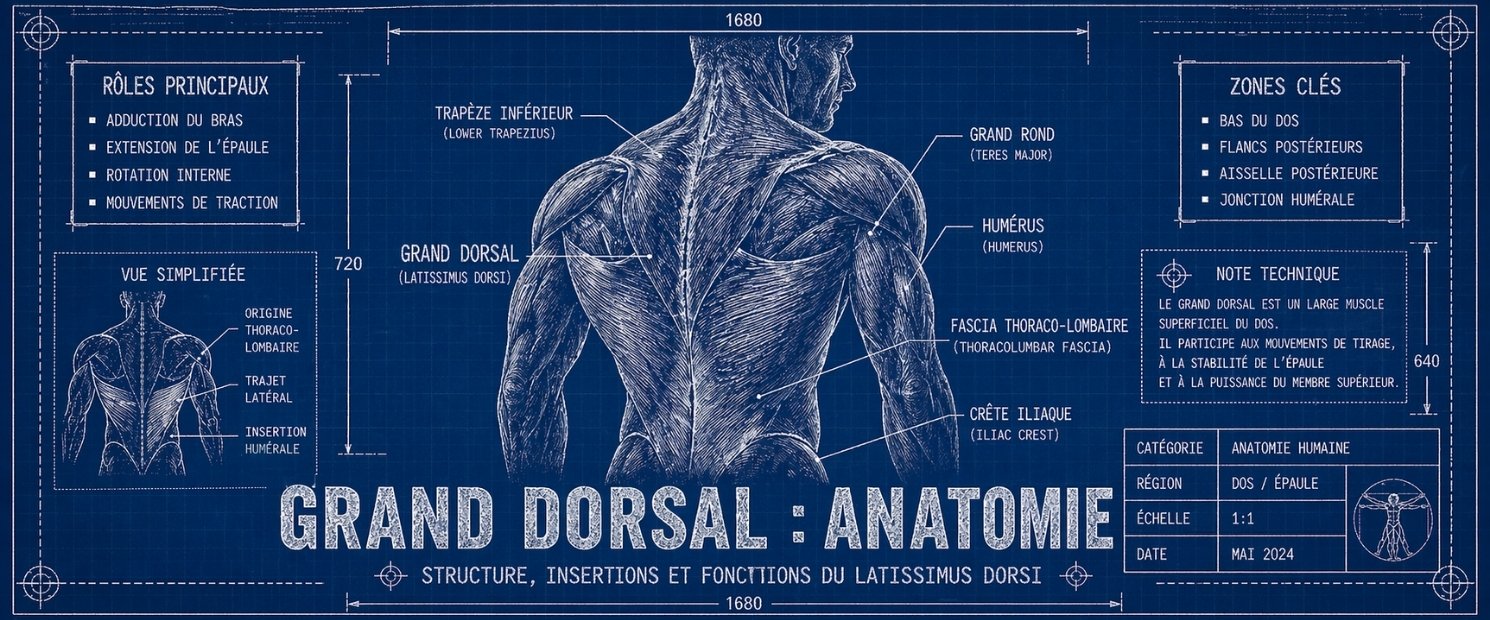
Latissimus Dorsal: a key muscle for the back, shoulder and posture
The latissimus dorsi is one of the best-known muscles of the back, and also one of the most useful in everyday life and in bodybuilding. It is involved in pulling movements, shoulder stability, certain powerful sports movements and the general appearance of the upper body. When a practitioner seeks to broaden their back, improve their posture or better control their arm movements, they almost always work this muscle, even without realizing it.
Research around latissimus dorsi muscle, latissimus dorsi exercise, latissimus dorsi anatomy, latissimus dorsi function or latissimus dorsi role clearly shows that this is a subject that is both aesthetic, functional and sometimes medical. Some people want to build it up better. Others seek to understand a discomfort. Still others are interested in its role in latissimus dorsi muscle breast reconstruction.
This broad, flat muscle connects the trunk to the arm. It is precisely this link that explains why latissimus dorsi pain can sometimes be felt in the back, under the armpit, along the side or up into the arm. To work on it well, stretch it or interpret pain, you must start by understanding its anatomy and its functions.
Latissimus Dorsal Anatomy: where is this muscle located and how is it organized?
The query latissimus dorsi anatomy comes up often, because this muscle is larger than we imagine. The latissimus dorsi covers a large portion of the lower and lateral region of the back. It extends from the trunk towards the humerus, making it a muscular bridge between the back and the arm. In English, it corresponds to latissimus dorsi, which explains the searches for latissimus dorsi in English, latissimus dorsi in English muscle, latissimus dorsi muscle in English, latissimus dorsi muscle in English and latissimus dorsi muscle in English.
In anatomical bases, it is described as a large, superficial, flattened and powerful muscle. This is what also explains the queries latissimus dorsi muscle anatomy, latissimus dorsi superficial muscle and latissimus dorsi deep muscle. In practice, the latissimus dorsi is considered a superficial muscle of the back, even if it covers or crosses areas related to deeper structures.
Latissimus dorsi insertion, high insertion, low insertion and humerus
The question of integration is central. We find the searches for latissimus dorsi insertion, latissimus dorsi muscle insertion, latissimus dorsi insertion humerus, latissimus dorsi insertion high, latissimus dorsi insertion low, latissimus dorsi short insertion and even latissimus dorsi insertion scapula.
In practice, the latissimus dorsi originates from several structures of the trunk, notably at the level of the lower thoracic vertebrae, the thoracolumbar fascia, the iliac crest and the last ribs, then ends on the humerus. This humeral ending explains why it acts directly on the movement of the arm and not just on the back. It is not classically inserted on the scapula as the main site, which explains why some research exists, but often results in frequent anatomical confusion.
This architecture makes it a very interesting muscle in bodybuilding, because it transforms an arm movement into massive work of the entire lateral back.
Latissimus Dorsal Function and Latissimus Dorsal Role
The searches for latissimus dorsi function, latissimus dorsi function, latissimus dorsi role and latissimus dorsi role answer a real question: what exactly does the latissimus dorsi do?
Its main role is to help bring the arm toward the body, pull the arm backward, participate in shoulder adduction and extension, and assist certain internal rotation movements. This is why it is so widely used in vertical pull-ups, pull-ups, rows, certain pulley pull-downs and several dynamic core exercises.
In daily life, it is also used to pull an object towards you, climb, push the body upwards on a bar, stand up on certain supports and stabilize the upper trunk during more powerful efforts. Among athletes, it contributes significantly to swimming, climbing, rowing, gymnastics, bodybuilding and many throwing sports.
Latissimus Dorsal Exercise: how to strengthen it properly
The latissimus dorsi exercise is one of the major subjects of back strength training. Practitioners generally want to either gain back width, or feel this muscle better, or find variations adapted to their gym or their level. The research latissimus dorsi muscle exercise, latissimus dorsi muscle exercise, latissimus dorsi exercises and latissimus dorsi muscle exercise clearly show this expectation.
To work it well, you must favor exercises that bring the arm closer to the trunk or that bring the arm backwards with control. The best known movements are pull-ups, high pulley pull-downs, certain rows, pullovers and several variations of unilateral pull-downs.
Latissimus dorsi pulley exercise and latissimus dorsi high pulley exercise
The latissimus dorsi pulley exercise is one of the most frequently searched for, because the pulley allows you to maintain regular tension and better control the trajectory. The high pulley latissimus dorsi exercise is probably the most popular version, especially with chest pulls in wide grip, neutral grip or close grip depending on the objectives.
The pulley is particularly interesting for learning to feel the latissimus dorsi. Many practitioners use their arms or trapezius too much at first. With a good trajectory and a well-chosen load, the pulley helps to better connect the arm to the back.
Latissimus dorsi exercise machine
The latissimus dorsi exercise machine attracts practitioners who want more stability. A guided or convergent pulling machine often allows you to better concentrate on the contraction and limit certain lower back compensations. In the gym, this can be very useful for longer series or for beginners.
Research like latissimus dorsi exercise room and latissimus dorsi exercise gym also shows that many simply want to know which exercises to incorporate into their routine. In practice, a balanced back session often combines a vertical pull, a horizontal pull and sometimes an isolation or active stretching movement.
Latissimus dorsi exercise without equipment
The latissimus dorsi exercise without equipment or latissimus dorsi without equipment is entirely possible, even if it is a little more difficult to load than in the gym. This muscle can be worked with pull-ups on a fixed bar, suspended variations, certain body weight movements, dynamic core training or exercises with a towel and domestic support.
The research latissimus dorsi muscle without equipment, latissimus dorsi exercise at home and latissimus dorsi muscle exercise without equipment show that there is a real demand for home workouts. The easiest way is often to use a pull-up bar, but certain self-resistance or elastic variations can also help.
Latissimus Dorsal Stretching: why and how to soften it
The latissimus dorsi stretching is useful in several situations: after a back session, in the event of a feeling of stiffness, in certain postural contexts or to improve amplitude above the head. The searches for latissimus dorsi stretching, latissimus dorsi stretching, physiotherapist latissimus dorsi stretch, standing latissimus dorsi stretch, seated latissimus dorsi stretch, straight latissimus dorsi stretch, straight latissimus dorsi stretch, wall latissimus dorsi stretch and latissimus dorsi stretching against a wall show that many are looking for simple and accessible versions.
Standing latissimus dorsi stretch
A good standing latissimus dorsi stretch often consists of placing the hands high on a support, then moving the hips back while keeping the back long to feel the stretch under the arms and on the sides of the trunk. This stretch is especially helpful after pull-ups, pull-ups, or swim work.
Latissimus dorsi stretch against a wall
The latissimus dorsi stretch against a wall is a simple variation to implement. By placing one or both hands against a wall, then moving your torso back slightly, you can create a controlled stretch under the armpit and on the lateral part of the back. This is a good option for those who want a precise gesture, without equipment.
Seated latissimus dorsi stretch
The seated latissimus dorsi stretch can be done by placing your arms on a support in front of you and gently bringing your torso towards the ground or forward. It is well suited to people who want to avoid compensation in the lower back or who prefer a more stable position.
Latissimus Dorsal Pain: how to read the symptoms
Research around pain is particularly numerous: latissimus dorsi pain, latissimus dorsi muscle pain, latissimus dorsi muscle pain, left latissimus dorsi muscle pain, right latissimus dorsi muscle pain, latissimus dorsi pain, latissimus dorsi muscle pain, latissimus dorsi muscle pain, latissimus dorsi pain which makes ache, left latissimus dorsi pain, right latissimus dorsi pain, left latissimus dorsi pain, right latissimus dorsi pain, right latissimus dorsi pain, right latissimus dorsi muscle pain and latissimus dorsi arm pain.
This diversity clearly shows that pain can be felt in several areas. It can be located on the side, under the shoulder blade, near the armpit, in the lower lateral back, or project towards the arm. A simple muscular overload can explain some of this pain, particularly after pull-ups, rowing, gardening, repetitive movements or an intense back session.
When the latissimus dorsi is overloaded, it can become sensitive, stiff, or produce more severe pain during certain pulling or raising movements of the arm. Localized discomfort may also appear in the event of elongation or excessive compensation.
Latissimus dorsi arm pain
The search for latissimus dorsi arm pain may be surprising, but it is explained by the humeral insertion of the muscle. As the latissimus dorsi ends on the humerus, significant irritation or tension may be felt in the area near the armpit or upper arm. This is not to say that all arm pain comes from the latissimus dorsi, but this projection is anatomically consistent.
Left latissimus dorsi muscle pain
left latissimus dorsi muscle pain is a very representative research. In the gym, this pain can appear after a poorly controlled pull, a pull that is too heavy, an excessive volume of rows or a lack of recovery. The latissimus dorsi works a lot in pulling movements, but it can also compensate if the technique is not good or if shoulder mobility is limited.
Latissimus Dorsal Elongation, Extension and stretching discomfort
The searches for latissimus dorsi elongation, latissimus dorsi extension and latissimus dorsi stretching pain show that some Internet users are looking to know if the muscle can be “pulled” or injured. Yes, like any heavily used muscle, the latissimus dorsi can be overstretched or overloaded. This can happen during a violent pull, an explosive movement, a poorly controlled pull or an unusual effort with the arm above the head.
A sharp, sudden pain, accompanied by a clear weakness or a hematoma should be taken seriously. Simple stiffness after exercise is different from a real muscle injury. If in doubt, reduce training and seek medical advice.
Latissimus Dorsal Muscle Breast Reconstruction: why this muscle is sometimes used
The keyword latissimus dorsi muscle breast reconstruction or breast reconstruction latissimus dorsi pain refers to a very specific medical subject. The latissimus dorsi can be used in certain breast reconstruction techniques, particularly in the form of a flap. In this context, the muscle is mobilized as reconstruction tissue.
This explains why some patients are looking for information on pain, post-operative discomfort or functional recovery after this type of intervention. This is a very specific context, which requires specialized surgical follow-up. A general information article can explain the principle, but never replaces the instructions of the medical team.
Large Dorsal Innervation: a useful point to understand its function
The research latissimus dorsi innervation and latissimus dorsi root innervation shows that some readers want to go further. The latissimus dorsi is innervated by the thoraco-dorsal nerve. This anatomical precision especially helps to understand why certain nerve damage or specific surgeries can influence its function.
When reading for the general public, it is enough to remember that the innervation is specific and consistent with its powerful motor role in the movements of the arm and trunk.
Long dorsi, latissimus dorsi and other common confusions
The queries long dorsal pain, long dorsal muscle pain, left long dorsal pain, right long dorsal pain, long dorsal exercise, long dorsal insertion or long dorsal ligament origin and insertion show that there is often confusion between several terms. In everyday French, some people say “long dorsal” to talk about back pain or a posterior muscular area, whereas the latissimus dorsi and the long muscles of the spine are not the same structures.
This confusion is common online. It is therefore necessary to clearly distinguish the latissimus dorsi, a large and lateral muscle of the back, from the spinal erectors and other more longitudinal paravertebral muscles.
Latissimus Dorsal Home Exercise: a simple routine
For those looking for a home latissimus dorsi exercise, an effective foundation may include:
- pronation or neutral pull-ups if you have a barbell;
- pull with elastic towards the chest;
- elastic or light load pullover;
- unilateral row with weighted bag or dumbbell;
- suspension work and scapular control.
This routine allows you to recruit the latissimus dorsi without complex equipment. The most important thing is to stay consistent with your level and avoid sudden movements if the muscle is already sensitive.
Conclusion: the latissimus dorsi, a major muscle to understand and respect
To progress, you must choose consistent exercises, build good technique, respect recovery and not trivialize persistent pain. A strong latissimus dorsi improves back quality, posture, pulling strength and overall upper body stability.