

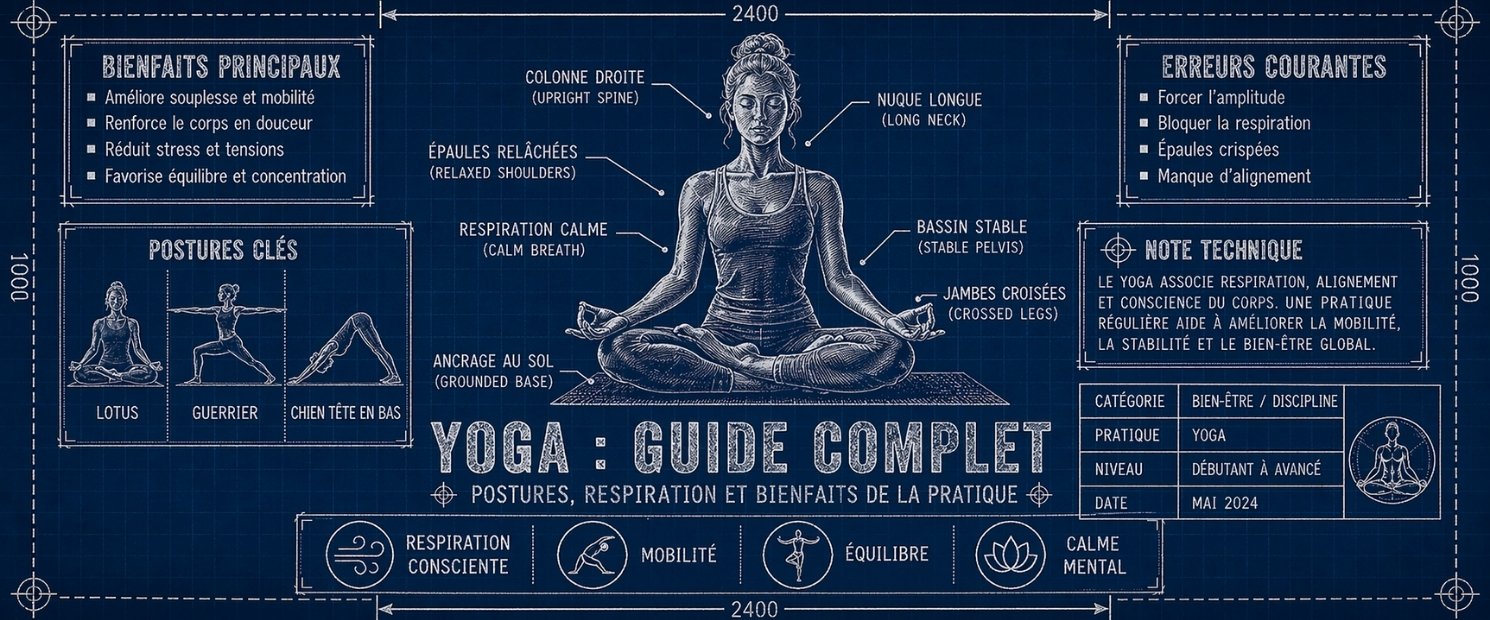
Yoga is a global practice that connects the body, breath and attention. Behind this well-known word, there is not just one way of practicing, but a great diversity of approaches. Some forms of yoga are dynamic and physical. Others are slow, meditative, restorative, or energy focused. This explains why the same person can enjoy very invigorating yoga at one point in their life, then turn to a gentler, more introspective or more therapeutic practice later.
When trying to understand the different styles, it is useful to distinguish two realities. On the one hand, there are the great traditions and historical paths of yoga. On the other hand, there are modern styles taught today in the studio, gym, online or at home. These universes often overlap, but they do not always mean the same thing. A yoga class can be very physical, while the philosophy of yoga goes far beyond postures.
In this article, you will discover the main types of yoga, their differences, their audience, their objectives, their benefits and their limits. The idea is not just to give definitions. The objective is also to help you understand which yoga can correspond to your level, your energy, your physical condition and your current intention.
What is yoga in the broad sense?
Yoga is an ancient discipline born in India. In its deeper sense, it is not limited to gentle gymnastics or a series of stretches. Yoga designates a path of personal transformation based on presence, breathing, concentration, inner discipline and the relationship between body and mind.
In modern practice, many people enter yoga through postures, called asanas. It’s a very concrete gateway. However, yoga also includes the work of breathing, called pranayama, meditation, relaxation, concentration, ethics and sometimes a more marked spiritual dimension depending on the school.
This explains why two yoga classes can be very different. One may look like a smooth, sustained workout. The other can be experienced almost like a deep rest session. Both are yoga, but do not require the same qualities.
The big families of yoga: how to find your way around them?
To understand the diversity of yoga, we can organize the styles into several large families. This classification is not perfect, but it helps a lot to get your bearings better.
Postural yoga
They emphasize postures, alignment, mobility, strengthening, breathing in movement and body awareness. This is the case of hatha yoga, vinyasa yoga, ashtanga yoga, Iyengar yoga or even power yoga.
Deep relaxation yoga
They mainly seek to calm the nervous system, slow down and promote relaxation. It includes yoga nidra, restorative yoga and, to a certain extent, certain slow practices of yin yoga.
Energy yogas
They give an important place to the circulation of energy, to breath, to sounds, to symbolic gestures or to inner awakening. kundalini yoga is the best-known example today.
Philosophical and spiritual paths
They go beyond the framework of the modern yoga class based on postures. We think in particular of raja yoga, bhakti yoga, karma yoga and jnana yoga. These paths are fundamental to understanding yoga in its depth.
Hatha yoga: the most famous foundation
Hatha yoga is often presented as the most accessible form to start with. In the West, this term generally refers to a classic, posed, structured yoga, in which the postures are held longer than in very fluid styles. The pace is often moderate. The course allows time to settle in, breathe and understand the investments.
Hatha yoga is very suitable for beginners, people who want to discover the basics, those who are looking for complete but not rushed work, and those who wish to better understand the technique of the postures. It develops flexibility, tone, breathing and body awareness.
However, you should know that the word hatha also has a broader meaning in the tradition. Historically, it refers to a whole set of bodily and energetic practices. In a modern studio, however, it most often refers to a balanced, stable and accessible course.
Vinyasa yoga: fluid and rhythmic yoga
vinyasa yoga is based on the sequence of postures with breathing. Here, the movement is more continuous. We move from one posture to another according to a logic of flow. The course can be very creative, very dynamic or gentler depending on the teacher, but it often maintains a feeling of fluidity.
Vinyasa is very popular with people who like to move, sweat a little, work on coordination and feel a more alive side than in very static yoga. It develops muscular endurance, mobility, breathing and concentration.
On the other hand, it can be less reassuring for a complete beginner if the pace is too fast. It all depends on the pedagogy of the course. A slow vinyasa can be very suitable for someone who is just starting out, while an advanced vinyasa will already require technique and breathing.
Ashtanga yoga: a codified and demanding method
Ashtanga yoga is a form of dynamic yoga based on series of fixed postures, practiced in a precise order. It is a demanding, structured and intense method, which requires discipline, regularity and physical commitment.
Each session follows a defined progression. This really appeals to practitioners who like benchmarks, repetition and the idea of a very clear progression. Ashtanga develops strength, endurance, mobility, concentration and mentality.
This practice does not suit everyone at the same time. It can be very stimulating for some people, but too intense for others, especially in cases of fatigue, joint pain or the need to slow down. Supervision and adaptation are therefore essential.
Iyengar yoga: precision, alignment and pedagogy
Iyengar yoga is recognized for its attention to alignment, precision of postures and the use of accessories such as blocks, straps, blankets or chairs. This method gives great importance to technical detail.
It is particularly suitable for people who like to understand in depth how the body is organized in each posture. It is also very relevant for those who need adaptations, who wish to progress safely or who want to build good foundations.
The rhythm may seem less fluid than in other styles, but this apparent slowness is also a strength. It allows you to learn with finesse, correct postural habits and develop lasting bodily intelligence.
Kundalini yoga: energy, breath, sounds and inner transformation
kundalini yoga is one of the most unique styles. It combines postures, breathing exercises, repetitions, hand gestures, sounds, mantras and sometimes active meditations. His intention is not just physical. It seeks to act on energy, vitality, the nervous system and the inner state.
In a kundalini class, we often find specific series called kriyas. The experience can be very different from classic postural yoga. Some sequences are dynamic, others repetitive, others very meditative. The atmosphere can be surprising at first, especially if you come from a purely physical yoga.
Kundalini yoga attracts people who are looking for an energizing, introspective or more spiritual practice. It can help work on breathing, presence, stress management and vitality. On the other hand, it requires being comfortable with a more symbolic and more ritual approach than other modern forms.
Yoga nidra: the yoga of conscious sleep
yoga nidra is a deep guided relaxation practice. It's often called sleep yoga, but it's not actually about sleeping. The practitioner remains between wakefulness and deep relaxation, in a particular state of consciousness.
Concretely, a yoga nidra session is often done lying on your back, eyes closed, following the voice of the teacher. There are almost no physical postures in the usual sense. The work is mainly based on attention, progressive relaxation, breathing, visualization and exploration of the inner state.
Yoga nidra is particularly sought after to reduce stress, improve sleep, ease mental burden and promote nervous recovery. It is very suitable for people who are tired, anxious, overstimulated or in need of a deep break. It is a powerful, accessible and often underestimated practice.
Yin yoga: slowness, relaxation and work on deep tissues
yin yoga is a slow yoga in which the postures are held for a long time, sometimes several minutes. The goal is not performance or sequence. It's more about settling into a form, releasing what can be released and working in depth on mobility, fascia, connective tissues and inner presence.
Yin yoga can seem very gentle from the outside. However, it requires a real quality of patience, listening and letting go. Certain postures become intense because we give them time to act.
This practice is very suitable for those who experience a lot of tension, who need to slow down, or who are looking for an interesting complement to more explosive or faster sports. Yin is often appreciated by runners, stressed people and very active people who have difficulty stopping.
Restorative yoga: deep recovery
Restorative yoga is even more calming than yin in many cases. Here, the postures are largely supported by accessories. The objective is not to stretch intensely, but to create the conditions for complete relaxation.
This approach acts directly on relaxation, recovery and the parasympathetic nervous system. It can be very beneficial in times of fatigue, light convalescence, mental overload or chronic stress. It is a yoga that welcomes rest as a practice in itself, which is very precious in an often saturated daily life.
Power yoga: the tonic and sporty version
power yoga is a modern yoga, often inspired by vinyasa and ashtanga, but presented in a more fitness form. It focuses on strengthening, intensity, fluidity and sometimes cardio.
This style is very popular with people who like to feel the effort, work on strength, tone the whole body and find a very physical dimension in yoga. It can be motivating, energizing and effective in developing a good level of physical fitness.
On the other hand, power yoga is not necessarily the best entry point for a person who is very stiff, very tired or a complete beginner. It already requires a little coordination and a certain tolerance for effort.
Bikram yoga and hot yoga: yoga practiced in the heat
Bikram yoga is a method based on a fixed series of postures practiced in a heated room. hot yoga, for its part, refers more broadly to different forms of yoga practiced in a hot environment, without necessarily following the Bikram method.
Heat modifies sensations. It can give the impression of flexibility more quickly and make you sweat profusely. Some people love this intensity and this feeling of purification. Others experience it as an additional constraint or fatigue.
These practices require hydrating yourself well, listening to your limits and remaining cautious if you don't tolerate heat well, if you are very sensitive to dehydration or if you have certain cardiovascular weaknesses. They are not essential to benefit from the benefits of yoga.
Sivananda yoga: a traditional and complete approach
Sivananda yoga is based on a classic structure including breathing, salutations, postures, relaxation and sometimes meditation or chanting. It is part of a more global tradition, with a more visible philosophical dimension than in certain purely modern courses.
This form of yoga is often appreciated by people who want a complete, balanced practice that is faithful to a certain tradition. The framework is clear, the rhythm is often measured, and the session seeks to harmonize rather than perform.
Jivamukti yoga: a modern, committed and spiritual yoga
The Jivamukti yoga mixes dynamic postural practice, breathing, music, philosophy and sometimes ethical commitment. It is a modern style, but nourished by strong spiritual references.
It can appeal to people who want a living, demanding and meaningful yoga. Jivamukti does not stop at the mat. It often links bodily practice, self-awareness and reflection on the way of living.
Anusara yoga: openness, alignment and intention
Anusara yoga emphasizes alignment, the opening of the heart, the quality of intention and an often positive and precise pedagogy. It is aimed at those looking for both technical structure and a more inspiring dimension.
Like other modern schools, it developed its own language and its own way of teaching. Some find it a motivating framework, others prefer more sober approaches. The choice really depends on each person's sensitivity.
Viniyoga: adapting the practice to the person
viniyoga is based on a simple but essential idea: the practice must adapt to the person, and not the other way around. This means that we adjust the postures, breathing, rhythm and progression according to the age, physical state, needs and objectives of the practitioner.
This approach is particularly relevant in individual support, recovery, in a therapeutic context or for people who do not identify with standardized courses. Viniyoga puts personalization at the center.
Prenatal yoga: yoga during pregnancy
Prenatal yoga is designed to accompany pregnancy safely and gently. It helps to breathe better, mobilize the pelvis, relieve certain tensions, develop body awareness and prepare for childbirth.
Not all forms of yoga are equally suitable during pregnancy. This is why a specially adapted practice remains the best option. Prenatal yoga promotes listening, comfort, breathing and stability, without seeking performance.
Postnatal yoga: resume after childbirth
Postnatal yoga supports the gradual return to movement after childbirth. It often targets breathing, the pelvic floor, overall recovery, posture and reconnection to the body.
This practice can be very valuable, provided it is well supervised and adapted to the person's time of recovery. Here again, progressiveness counts more than intensity.
Chair yoga: chair yoga
Chair yoga, or chair yoga, makes the practice accessible to a wide variety of audiences, including seniors, people with mobility limitations, those who work seated for a long time or those who want a gentler and safer form.
Practicing with a chair does not reduce the interest in yoga. On the contrary, it can allow you to work on breathing, mobility, alignment and presence with great comfort. It’s a great gateway for many people.
Aerial yoga: yoga with a hammock
Aerial yoga, sometimes called aerial yoga, uses a suspended hammock to practice certain postures. This approach completely modifies sensations, particularly in inversions, stretching and decompression work.
It appeals to people who love exploration, play, the feeling of lightness and sensory experience. But it also requires a secure framework, good support and appropriate progression.
Acro yoga: yoga in pairs or in groups
acro yoga combines yoga, gentle acrobatics, balance and relational confidence. It is often practiced in twos or more. This discipline develops communication, listening, core strength, balance and coordination.
It is not a traditional yoga in the strict sense, but a contemporary form very appreciated for its playful and collective dimension. It attracts people who like shared movement and interactive learning.
The main paths of traditional yoga: beyond postures
If we really want to understand “all types” of yoga, we must also look at the main traditional paths that structure the philosophy of yoga. They are not always lesson styles, but they are essential.
Raja yoga
raja yoga is often linked to the path of meditation, mental discipline and inner mastery. It is close to the classical view expounded in the Yoga Sutra.
Bhakti yoga
bhakti yoga is the path of devotion, song, heart and connection to the sacred. It can include mantras, rituals and a strong emotional and spiritual dimension.
Karma yoga
Karma yoga is the path of right action, service and commitment without excessive attachment to the result. It is a way of experiencing yoga in daily action.
Jnana yoga
jnana yoga is the path of knowledge, reflection, discernment and inner exploration through study and understanding.
Tantra yoga
tantra yoga is often misunderstood. In its traditional sense, it is not reduced to modern clichés. It is a broad set of practices and worldviews where energy, symbols, rituals, consciousness and inner transformation occupy an important place.
What are the benefits of yoga, all styles combined?
Even if each form of yoga has its own color, several benefits often recur when the practice is regular and well adapted. Yoga can improve mobility, strength, balance, posture, breathing, recovery and quality of attention.
On a mental level, it often helps to better manage stress, slow down the flow of thoughts, better feel one's limits and find a more stable relationship with the body. Some practices are very invigorating. Others are deeply restorative. The benefit therefore depends on the style chosen and the way of practicing.
What type of yoga should you choose according to your profile?
The best yoga is not the most fashionable. It is the one that corresponds to your current state, your real needs and your way of entering into the practice.
Getting started
Hatha yoga, Iyengar yoga, chair yoga or a beginner vinyasa are often good entry points. They allow you to understand the basics without going too quickly.
To move more
vinyasa yoga, power yoga and ashtanga yoga are best suited to those looking for a more sustained effort and a feeling of complete physical practice.
To relax deeply
yoga nidra, restorative yoga and yin yoga will often be the most appropriate. They help you relax, slow down and recover better.
To explore the energy dimension
kundalini yoga will often be the most striking style for people attracted to breath, energy, mantras and inner transformation.
For a very personalized practice
viniyoga or individual support will be particularly relevant for people with specific needs, pain, returning to activity or a targeted objective.
Can we practice several types of yoga?
Yes, and it’s often a very good idea. A person may practice dynamic yoga on certain days to work on strength and endurance, then choose yoga nidra, restorative, or yin on other times to recover and balance their nervous system.
Yoga does not have to be limited to just one school. It is often smarter to adapt the practice to your current energy. This flexibility makes yoga sustainable, vibrant and deeply useful.
Should you choose gentle yoga or intense yoga?
It all depends on your real needs. Many people think they need dynamic yoga because they want to “do something.” However, if the body is already very stressed, very tired or overworked, a gentle practice can sometimes be more beneficial than additional effort.
Conversely, some people need movement, structure, body heat and physical engagement to feel good. It is therefore not a question of prioritizing styles, but of choosing the one that really responds to your context.
Conclusion: there is not one yoga, but yogas
Talking about “all types of yoga” actually amounts to exploring a large family of practices. hatha yoga offers a clear and accessible foundation. vinyasa brings fluidity. ashtanga offers a rigorous method. Iyengar yoga develops precision. kundalini yoga works on energy. yoga nidra opens the way to conscious rest. yin yoga and restorative yoga invite you to slow down. power yoga, hot yoga, chair yoga, aerial yoga or acro yoga meet even other expectations.
The most important thing is not to know all the names by heart. The most important thing is to understand what each style seeks to develop. Once this is clear, it becomes much simpler to choose a consistent, sustainable practice that suits you.
You might also like