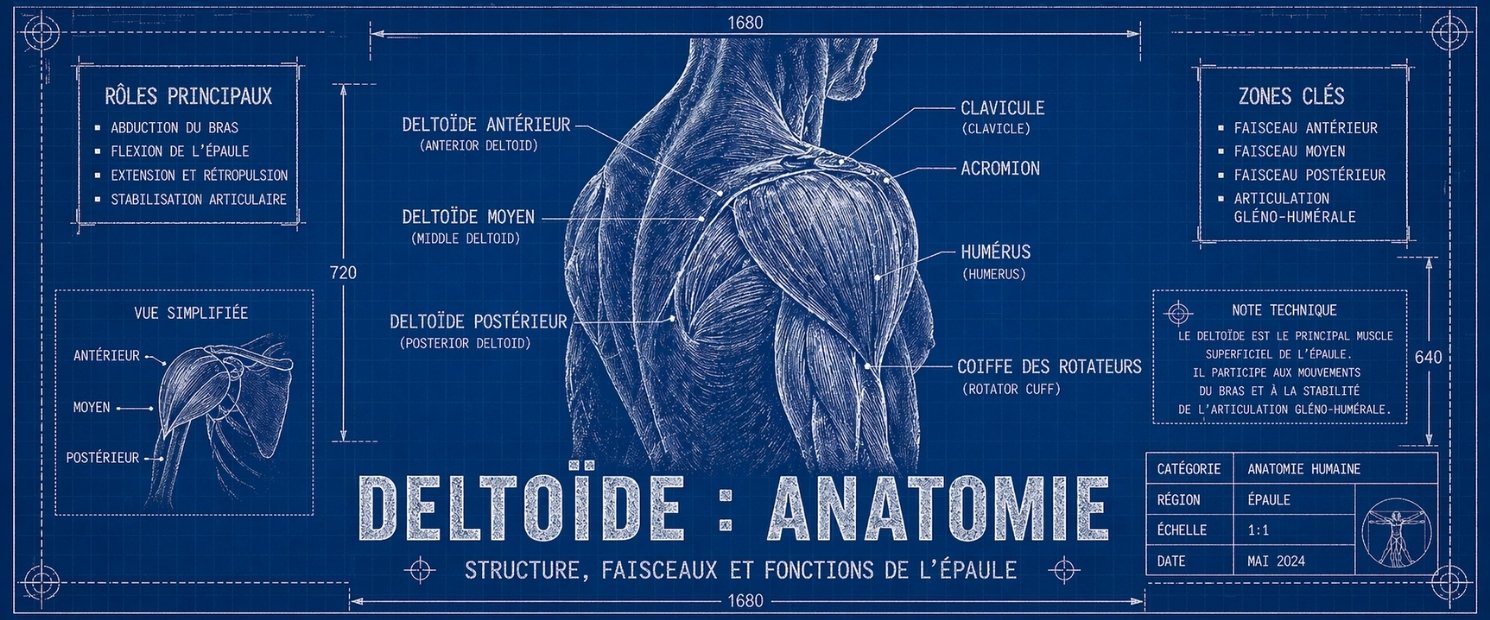
Deltoid: a central muscle for the shoulder and arm
The deltoid is one of the most well-known muscles of the upper body, yet it often remains misunderstood. Many bodybuilding practitioners only associate it with round shoulders and upper arm volume. In reality, the deltoid plays a much broader role. It participates in shoulder placement, arm movement, upper limb stability and many everyday actions such as raising the arm, pushing, pulling, carrying or throwing.
When we talk about deltoid muscle, we are talking about a triangular muscle that covers the external part of the shoulder. It provides much of the visible shape of the shoulder and is involved in several planes of movement. This is why searches related to deltoid shoulder, deltoid shoulder muscle, deltoid shoulder muscle and deltoid shoulder muscle building are also frequent.
The deltoid is not a single uniform block. It is divided into three large fascicles: the anterior deltoid, the middle deltoid and the posterior deltoid. Everyone has their dominant role, their preferred exercises and their overload issues. This explains the wealth of research around the subject: some people want an anterior deltoid exercise, others are looking for a medium deltoid exercise, a lateral deltoid exercise or even a posterior deltoid exercise.
Deltoid muscle anatomy: understand the structure before training
The query deltoid muscle anatomy is essential, because anatomy guides the choice of exercises. The deltoid arises from three bony areas of the shoulder complex: the clavicle for the anterior part, the acromion for the middle part, and the spine of the scapula for the posterior part. It ends lower on the humerus, at the level of the deltoid tuberosity. This explains why searches like deltoid muscle origin and insertion, deltoid muscle origin and insertion diagram, deltoid muscle origin and insertion and function, deltoid muscle origin and insertion nerve supply or deltoid muscle origin and insertion radiology come up so often.
We also find formulations like deltoid muscle anatomy, deltoid muscle structure, deltoid muscle anatomy 3d, deltoid muscle anatomy drawing, deltoid muscle anatomy ppt, deltoid muscle anatomy diagram, deltoid muscle anatomy radiology, deltoid muscle anatomy mri and deltoid muscle anatomy and physiology. This shows that the subject is of interest to athletes, students, health professionals and people who are simply trying to understand localized pain.
Anterior deltoid insertion, middle deltoid insertion and posterior deltoid insertion
The insertion logic deserves to be detailed. The anterior deltoid insertion depends on its clavicular origin and mainly accompanies forward movements. The middle deltoid insertion is organized around the acromion and is very involved in the lateral elevation of the arm. The posterior deltoid insertion arises from the spine of the scapula and is more involved in backward movements and in certain rotations.
English searches such as deltoid posterior insertion, posterior deltoid insertion and origin, deltoid lateral insertion, lateral deltoid insertion and origin, lateral deltoid insertions or muscle deltoid insertion correspond to the same expectation: understanding where each part of the muscle begins and ends. This understanding is useful because it explains why some exercises “burn” the front of the shoulder more, while others target the side or back.
Anterior deltoid function, middle deltoid function and posterior deltoid function
The functions of the three beams are complementary. The anterior deltoid function is mainly linked to shoulder flexion, that is, bringing the arm forward, as well as certain forms of internal rotation and pushing. The middle deltoid function is mainly to raise the arm to the side. As for the posterior deltoid function, it is more involved in extension, pulling backwards and certain external rotation actions.
These functional differences are why well-built shoulder workouts aren't limited to a single movement. A vertical press strongly stresses the front of the shoulder. A lateral elevation more likely targets the middle beam. A bird or pull face puts more emphasis on the posterior fascicle.
Search searches such as deltoid medium movement, deltoid lateral, deltoid posterior muscle, deltoid anterior muscle, deltoid lateral muscle or shoulder muscle deltoid posterior clearly show that Internet users are looking to connect movement, function and feeling.
Anterior deltoid: exercises, pulley, dumbbell and elastic
The anterior deltoid is often already heavily used by pushing exercises such as the bench press, the inclined press or the military press. This is why some people have an overly developed anterior deltoid in relation to the side or back of the shoulder. However, it may also require targeted work in certain cases, particularly in rehabilitation or in a more structured program.
Search searches like anterior deltoid exercise, anterior deltoid exercise, anterior deltoid bodybuilding, anterior deltoid pulley, anterior deltoid pulley, anterior deltoid dumbbell, anterior deltoid pulley exercise and anterior deltoid exercise elasticare very common.
Anterior deltoid pulley exercise
The pulley keeps a continuous tension, which is interesting for the anterior beam. A well-controlled front raise movement on the low pulley can be useful for working the front of the shoulder without parasitic movement. This variant is particularly appreciated for its fluidity and the ease of adjusting the trajectory.
Elastic anterior deltoid exercise
Elastic is a good homemade solution. It allows progressive work, often gentler on the joint, with increasing tension. For a beginner, this is an excellent way to learn to feel the anterior beam without heavy loading.
Middle deltoid, lateral deltoid and shoulder width work
The middle deltoid and the lateral deltoid are at the heart of the sensation of shoulder width. It is often this beam which gives the famous effect of wider shoulders. Searches like middle deltoid exercise, exo middle deltoid, lateral deltoid exercise, lateral deltoid exercise, external deltoid exercise or pulley lateral deltoid show this very well.
The best known work remains the lateral elevation. It can be done with dumbbells, on the pulley, on the machine or even with body weight in specific contexts. English variants like lateral deltoid muscle exercises, lateral deltoid muscle workout, lateral deltoid exercises dumbbell, lateral deltoid exercises machine, lateral deltoid exercises at home, lateral deltoid exercises bodyweight or lateral deltoid exercises without weights correspond to the same logic.
Middle deltoid pulley and lateral deltoid machine
The pulley is often one of the best tools for the medium beam, because it allows you to maintain tension in the lower part of the movement, where the dumbbell is sometimes less interesting mechanically. A variation of pulley middle deltoid or pulley lateral deltoid can therefore very effectively complement classic lateral raises.
Research such as deltoid lateral machine, deltoid lateral raise machine, side deltoid machine, lateral deltoid machine panatta or lateral deltoid machines also show that many practitioners appreciate dedicated machines. They simplify the trajectory and help limit trapezoid compensation.
Posterior deltoid: the great forgotten part of the shoulder
The posterior deltoid is often less developed than the front of the shoulder. Yet it plays a key role in posture, shoulder balance and pulling movements. Research around posterior deltoid bodybuilding, posterior deltoid exercise, exo posterior deltoid, exo posterior deltoid, exo rear deltoid, dumbbell rear deltoid, dumbbell posterior deltoid or dumbbell posterior deltoid clearly shows this need to catch up.
Pulley posterior deltoid and pulley rear deltoid
The pulley is particularly effective for the posterior beam. We thus find searches like pulley posterior deltoid, high pulley posterior deltoid, unilateral pulley posterior deltoid, pulley rear deltoid, post pulley deltoid, pulley posterior deltoid exercise, pulley posterior deltoid exercise and exo posterior deltoid pulley.
Pulley variations allow a finer pull backwards, with continuous tension and better control of the scapula. They are particularly useful if you want to isolate the back of the shoulder more and let the trapezius dominate less.
Posterior deltoid elastic exercise and body weight
The posterior beam is also worked with elastic. The queries posterior deltoid elastic exercise, posterior deltoid elastic and posterior deltoid elastic exercise show that many are looking for a home version. Opening pulls, reverse fly with band and some forms of bungee pull face are very useful.
There are also approaches in posterior body weight deltoid, even if they are less obvious to load. Certain variations in suspension or with support can already create a good stimulus.
Deltoid shoulder or back: where to classify the back of the shoulder?
The question deltoid shoulder or back often comes up, especially for the posterior fascicle. The answer depends mainly on the organization of the program. Anatomically, the deltoid clearly belongs to the shoulder. But in bodybuilding practice, the back of the shoulder can be worked on shoulder day or back day, because many pulls require it.
The most important thing remains the overall balance. If the front of the shoulder is already very well worked by the presses, it may be wise to place more emphasis on the middle and posterior in specific sessions.
Deltoid pain: how to interpret discomfort in this area
Research around pain is very numerous: anterior deltoid pain, posterior deltoid pain, lateral deltoid pain, medium deltoid pain, anterior deltoid bodybuilding pain, anterior deltoid pain, deltoid muscle pain, deltoid muscle pain shoulder, deltoid shoulder pain, deltoid arm pain, deltoid pain right arm, deltoid pain left arm, shoulder pain deltoid anterior or even lateral deltoid muscle pain.
We must remain nuanced. Pain felt in the deltoid area does not always mean that the deltoid is the actual structure involved. The shoulder is a complex joint. Rotator cuff irritation, bursitis, neck discomfort or mechanical overload may be felt “on the deltoid”. Cleveland Clinic also indicates that pain in this area can appear in the event of repeated movements or overload of the shoulder. :contentReference[oaicite:1]{index=1}
Anterior deltoid bodybuilding pain
A anterior deltoid bodybuilding pain often appears in practitioners who push a lot: bench press, military press, dips, push-ups, incline press. If the front of the shoulder is already dominant and very stressed, it can become sensitive. We must then look at the balance of the program, the technique and the recovery.
Lateral deltoid pain and posterior deltoid pain
Middle or posterior bundle pain can come from too high a volume of lateral raises, poorly controlled bird movements, a lack of scapular stability or an already loaded posture. Here again, it is better to think in global mechanics rather than in simple local massage.
Deltoid shoulder tendonitis and deltoid arm tendonitis
Searches like shoulder tendonitis in the shoulder, deltoid tendonitis in the arm, shoulder tendonitis in the arm, shoulder tendonitis in the right arm, shoulder tendonitis in the left arm, shoulder tendonitis in the right arm what to do, shoulder tendonitis in the right arm, Shoulder Arm Wrist Tendonitis, Shoulder Arm Sling Tendonitis, Shoulder Tendonitis Left Arm Symptoms and Shoulder Arm Tendonitis Swollen show that many use the word tendinitis to describe any shoulder pain.
In practice, too rapid self-diagnoses should be avoided. A true tendinopathy of the shoulder cannot be managed like a simple ache. When the pain is persistent, nocturnal, radiating or severely limiting, medical advice should be sought. NHS and orthopedic sources also point out that certain exercises can help, but that they must remain progressive and adapted to the pain. :contentReference[oaicite:2]{index=2}
Deltoid muscle vaccine: where is the injection given in the arm?
The group of keywords around vaccination is very specific: deltoid muscle vaccine, deltoid muscle vaccine photo, deltoid muscle vaccine child, deltoid muscle arm vaccine, deltoid muscle vaccine site, deltoid muscle vaccine technique, deltoid muscle vaccine injection, deltoid muscle vaccine administration, deltoid muscle rabies vaccine, deltoid muscle injury vaccination, deltoid muscle arm injection, deltoid muscle arm child and deltoid arm vaccine.
In adults, the deltoid of the upper arm is the most common recommended site for many intramuscular vaccine injections, with precise anatomical location to avoid an injection that is too high or too low. The CDC states that the IM injection is given at 90 degrees into the deltoid muscle of the upper arm in most adults, using clear bony landmarks. :contentReference[oaicite:3]{index=3}
This point is important, because some local pain after injection can be linked to an expected reaction, while a poorly placed technique can create more unusual discomfort. This also explains searches like deltoid muscle pain after injection or deltoid muscle injury vaccination.
Deltoid arm, deltoid region and upper arm
The queries arm deltoid, arm deltoid region, arm deltoid muscle, upper arm deltoid muscle and upper arm deltoid muscle refer to the practical location of the deltoid. This is the muscle visible on the outer and upper part of the arm, just below the shoulder. This area is often used as a marker for pain, training and injections.
It must be remembered, however, that pain felt in this region can come from other neighboring structures. The deltoid is a useful landmark, but not always the isolated structure involved.
Deltoid antagonist muscle and shoulder balance
Research deltoid muscle antagonist or antagonist to the deltoid muscle shows a desire to understand muscular balance. In reality, the deltoid does not have a single simple antagonist, because its fascicles do not all have the same function. The back muscles, the internal and external rotators, the rotator cuff and certain pectoral or scapular muscles participate in this balance.
This is why a beautiful shoulder is not built only with lateral elevations. It is also built with pulling, scapular work and a good balance between pushing and pulling.
Useful exercises for each portion of the deltoid
Anterior deltoid
- Military development.
- Seated dumbbell press.
- Front raise to the pulley.
- Bungee front elevation.
Middle deltoid
- Dumbbell lateral raises.
- Pulley Lateral Raises.
- Dedicated side machine.
- Strict standing or sitting variants.
Posterior deltoid
- Dumbbell bird.
- Reverse fly to the pulley.
- Pull face.
- Rear shoulder machine.
This distribution makes it possible to better target each fascicle and avoid the classic trap of a very strong anterior deltoid, but an insufficiently developed middle and posterior fasciculus.
Conclusion: the deltoid deserves precise, balanced and intelligent work
The deltoid is much more than just a shoulder muscle. Between anterior deltoid, middle deltoid, posterior deltoid, research into anatomy, insertions, functions, pulley, elastic, dumbbell exercises, pain, vaccination and muscular imbalances, we understand that this is a central area for performance, posture and comfort of the upper body.
To train it well, you must respect its structure. The front of the shoulder should not crush the rest. The middle needs to be worked for width. The rear should be reinforced for balance and posture. And in the event of unusual or persistent pain, you must take a step back, reduce the overload and seek appropriate advice if necessary.
A strong, balanced, and well-understood deltoid improves the aesthetics, function, and overall quality of the shoulder. This is what makes precise and progressive work so interesting.
You might also like