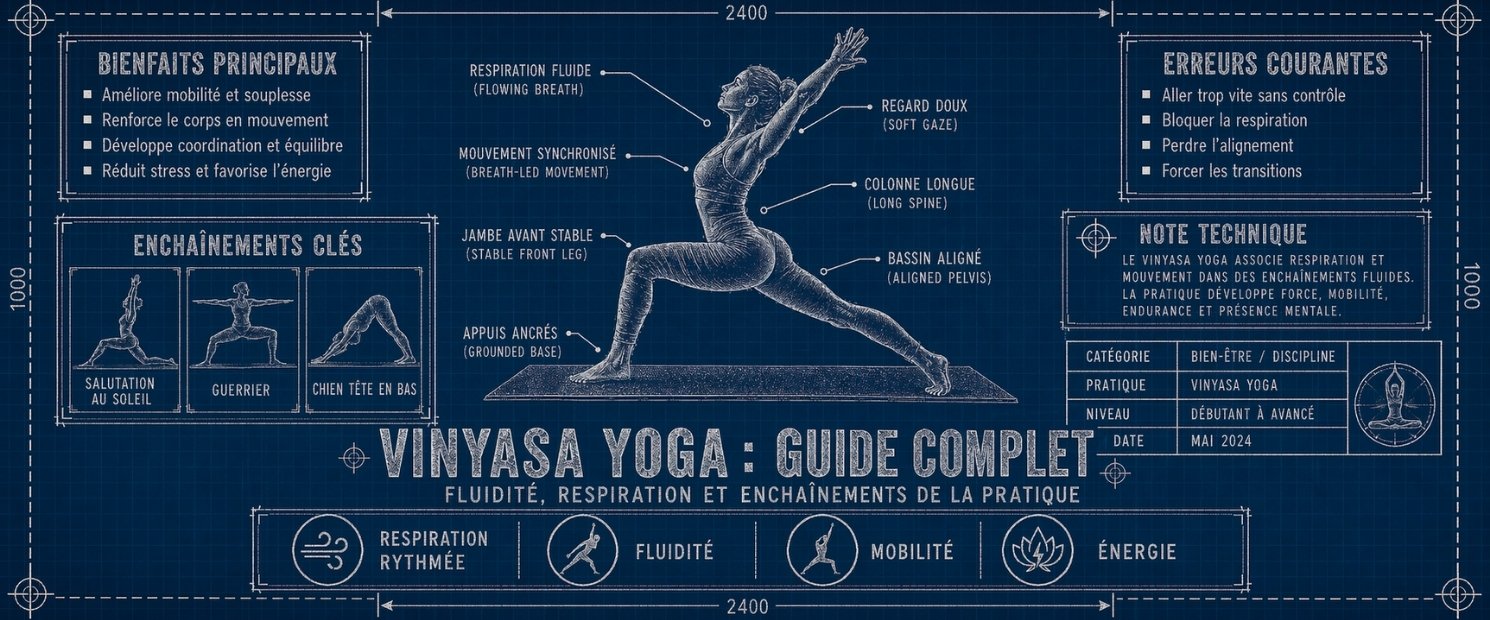
Vinyasa yoga: understanding a fluid, dynamic and structured practice
vinyasa yoga is attracting more and more practitioners, because it offers a complete experience of movement, breathing and concentration. This method is based on the sequence of postures in a fluid logic. Every transition has meaning. Each breath accompanies the action. The body moves forward with rhythm, but without losing precision.
When an Internet user searches for vinyasa yoga definition, they generally want to know what distinguishes this practice from a more static yoga. He also wants to understand if this style is accessible, what its effects are, how a session takes place and what type of practitioner it is aimed at. This research often overlaps with an intention of discovery, but also a need for comparison with other, more traditional approaches.
We also find queries like vinyasa yoga description, yoga vinyasa def or even vinyasa yoga explanation. This shows that users are not just looking for a theoretical definition. They want a clear, concrete and useful reading of this discipline. Vinyasa yoga is not just a quick sequence of postures. It is a coherent method, driven by breath, placement and attention.
Vinyasa yoga definition: what exactly are we talking about?
The simplest vinyasa yoga definition is to say that it is a dynamic yoga in which the postures follow one another in coordination with the breathing. Movement is therefore not separated from breathing. Each passage, each support and each change of shape follows a precise logic. This continuity creates a lively, rhythmic and often very physically engaging practice.
In a more complete vinyasa yoga explanation, it must be added that this approach also develops body awareness, mental stability and the quality of presence. Even though the pace may seem faster than in other styles, the goal is not to go fast for the sake of going fast. The goal is to connect action, breathing and attention in a single experience.
The formula yoga vinyasa def often comes up among Internet users who want a quick answer. We can summarize as follows: Vinyasa yoga is a flow yoga, where the breath guides the sequence of postures. But to fully understand it, we must also look at its history, its origin and its link with other branches of modern yoga.
Vinyasa yoga origin: where does this practice come from?
The research vinyasa yoga origin reflects a cultural and historical intention. The term “vinyasa” refers to the idea of organizing, placing or sequencing with intelligence. In contemporary practice, Vinyasa has largely developed from a modern reading of postural yoga, with a significant influence of dynamic methods from more codified traditions.
For many practitioners, Vinyasa evokes greater creative freedom in the construction of sessions. However, this freedom does not mean absence of structure. On the contrary, the sequences are often based on very precise principles: increase in intensity, work on breathing, progressive loading, stabilization, then return to calm.
Vinyasa is today practiced all over the world, in various settings. It can be found in an urban vinyasa yoga studio as well as in a more immersive vinyasa yoga ashram, or even in a vinyasa yogashala dedicated to a more regular and community practice.
Vinyasa yoga description: how a session takes place
A real vinyasa yoga description should help the reader imagine a class. A session often begins with refocusing. The practitioner sits down, observes his breathing, then prepares the body with a few simple movements. Then, the rhythm gradually settles. Standing postures, transitions, openings, balances and sometimes floor postures follow each other in a coherent manner.
Breath remains the common thread. We inhale to open, lengthen or elevate. We exhale to anchor, stabilize or further engage the center of the body. This logic gives the course its characteristic fluidity. This is what makes Vinyasa often felt alive, structured and very immersive.
In some classes, the intensity is gentle and progressive. In others, she may be more athletic. This is why it is always useful to look at the level of the course, the style of the teacher and the space given to options. A good Vinyasa adapts to the level of the practitioner. It is not limited to reproducing an external form.
Vinyasa yoga benefits: why this practice is so popular
Research around vinyasa yoga benefits shows that many people want to understand what this discipline can bring them on a daily basis. The benefits most often cited concern mobility, tone, coordination, breathing and concentration. Vinyasa acts on the whole body, but it also strongly mobilizes the attention.
On a physical level, it helps develop functional strength, particularly in the legs, shoulders, back, arms and abdominal muscles. It also improves active flexibility, because the postures are integrated into an overall movement. On the respiratory level, he learns to better synchronize the effort with the breath. This changes the way we experience exercise.
On a mental level, Vinyasa can produce a very particular effect. As we must remain attentive to the breath, rhythm and placement, the mind becomes less dispersed. This quality of concentration is of interest to both athletes and people looking for refocusing.
The benefits most often observed
- improve mobility and range of motion;
- strengthen the core of the body and general stability;
- develop muscular and respiratory endurance;
- better coordinate movement and breathing;
- promote concentration and mental presence;
- find a complete and regular physical practice.
Vinyasa yoga postures: which positions are found most often?
The search for vinyasa yoga postures is one of the most frequent, because many Internet users want to know what this practice actually looks like. The postures vary according to the teachers and the objectives of the session, but some recur very often. For example, we find the mountain, the plank, the downward facing dog, the cobra, the upward facing dog, the warriors, the chair, the crescent and different twists.
These positions are not isolated. They are part of a logic of circulation. This is precisely what differentiates Vinyasa from a more static class. The vinyasa yoga postures take on meaning in their sequence. The practitioner learns the transitions as much as the postures themselves.
The notion of vinyasa yoga position also comes up in research. It often reflects a very concrete need: understanding the shape of the body, the points of support and the direction of movement. In this context, placement instructions are essential. Vinyasa is not just a visual flow. It’s alignment work in motion.
Examples of common Vinyasa postures
- the mountain for anchoring and starting posture;
- the board for core strength and stability;
- downward facing dog for lengthening and transition;
- warriors for power and openness;
- the chair for leg engagement;
- low lunges for pelvic mobility;
- standing or seated twists for spinal mobility;
- gentle forward bends and extensions to balance the sequence.
vinyasa yoga asana: why this term comes up often
The keyword vinyasa yoga asana shows that many users want to connect Vinyasa with traditional yoga vocabulary. An asana designates a posture. In Vinyasa, there are many asanas, but their interest does not only lie in their final form. They are experienced in a respiratory continuum and in a progressive construction of flow.
vinyasa flow yoga vinyasa postures
The formula vinyasa flow yoga vinyasa postures reflects a research intention focused on dynamic sequences. The user is generally looking for a set of postures to chain together, sometimes to practice alone, sometimes to better understand the content of a course. In this context, it is useful to remember that the flow must remain coherent. It’s not about stacking postures at random.
Vinyasa yoga postures pdf: why this query is common
The search vinyasa yoga postures pdf meets a practical need. Many people want to retain support, review a sequence, memorize sequences or practice offline. A good working document must present the postures, but also the logical order of the session, the level options and the points of vigilance.
The same reasoning applies to searches on visual formats. Practitioners want a quick reference. However, written or visual support is only valuable if it explains breathing, transitions and placement. Without it, the essential Vinyasa experience is missing.
Vinyasa yoga studio, vinyasa yogashala and vinyasa yoga ashram: what are the differences?
The searches for vinyasa yoga studio, vinyasa yogashala and vinyasa yoga ashram show that Internet users also want to understand the places of practice. A studio often corresponds to an urban space dedicated to group lessons. A yogashala more readily evokes a place centered on regular teaching, sometimes with a strong identity of practice. An ashram refers to a more global immersion, with a more marked dimension of life, study and discipline.
In a vinyasa yoga studio, the experience will often be more contemporary, more flexible and more linked to an urban pace of life. In a vinyasa yogashala, the emphasis can be placed more on regularity, method and community. In a vinyasa yoga ashram, the practice is often part of a more immersive and more structured approach.
These differences do not imply that one framework is better than another. They simply indicate different experiences. The choice depends on the time available, personal expectations and the level of commitment sought.
Vinyasa yoga: how to choose a good class
- the actual level announced;
- the duration and intensity of the course;
- the quality of breathing instructions;
- the place given to alignment;
- the possibility of adapting postures;
- the general atmosphere of the place and the group.
Vinyasa and Ashtanga: what real differences?
Internet users who are interested in Vinyasa often end up comparing this practice with Ashtanga. This makes sense, because both styles are dynamic and use structured sequences. However, they do not work in the same way. Vinyasa leaves more freedom in the construction of sequences. Ashtanga is based on codified and repeated series.
Searchs like ashtanga yoga postures or ashtanga yoga postures pdf clearly show that the public wants to understand if the positions are identical. In reality, certain postures can be found in both approaches, but their order, their place in the session and the general logic change a lot. Vinyasa is freer and more adaptable. Ashtanga is more fixed and more ritualized.
Ashtanga and Vinyasa: the main points of reference
- Vinyasa offers more variable sequences;
- Ashtanga follows precise and repeated series;
- Vinyasa adapts more easily to the theme of the class;
- Ashtanga often requires a more codified progression;
- both styles rely on breathing, but not on the same educational framework.
How to start Vinyasa yoga without getting lost
To get started well, you must avoid a common mistake: believing that Vinyasa consists only of following the rhythm of the group. Real progression begins with understanding the breath, supports and simple transitions. It is better to have a short, well-explained and breathable flow than a spectacular session that is too difficult to follow.
The beginner benefits from choosing an accessible course, practicing regularly and accepting adaptations. Bending your knees in downward dog, placing your knees in a plank or slowing down during a transition does not detract from the quality of the work. On the contrary, it helps build a more secure foundation.
Simple tips for progress
- start at a beginner or gentle intermediate level;
- favor the quality of the breath rather than the speed;
- learn a few benchmark postures before accelerating;
- respect the options currently proposed;
- practice regularly rather than intensely on an irregular basis.
Why Vinyasa yoga is so popular today
The success of Vinyasa yoga is due to its versatility. It can respond to a desire for movement, a need to refocus or a search for physical progress. It attracts people who want a living yoga, but also those who are looking for a demanding discipline without falling into a purely sporting logic.
Its richness also comes from the fact that it can evolve with the practitioner. At the beginning, we mainly discover breathing, transitions and basic postures. Over time, we refine alignment, deepen body awareness and develop a more subtle relationship with rhythm. It is this progressive depth that makes the practice sustainable.
Conclusion: Vinyasa yoga, a structured flow between breath, strength and presence
vinyasa yoga is not just dynamic yoga. It is a complete practice that links breathing, sequences, concentration and the quality of presence. Whether you are looking for a vinyasa yoga definition, guidelines on vinyasa yoga postures, a vinyasa yoga paris class or a better understanding of the vinyasa yoga benefits, you always come back to the same idea: a yoga of conscious movement.
Well guided, Vinyasa offers real progression. It develops fluidity, but also stability. It strengthens the body, without forgetting the breath. It mobilizes energy, while structuring attention. It is precisely this mix of intensity, precision and breathing that explains its success in studios, yogashalas and personal practices.
You might also like