

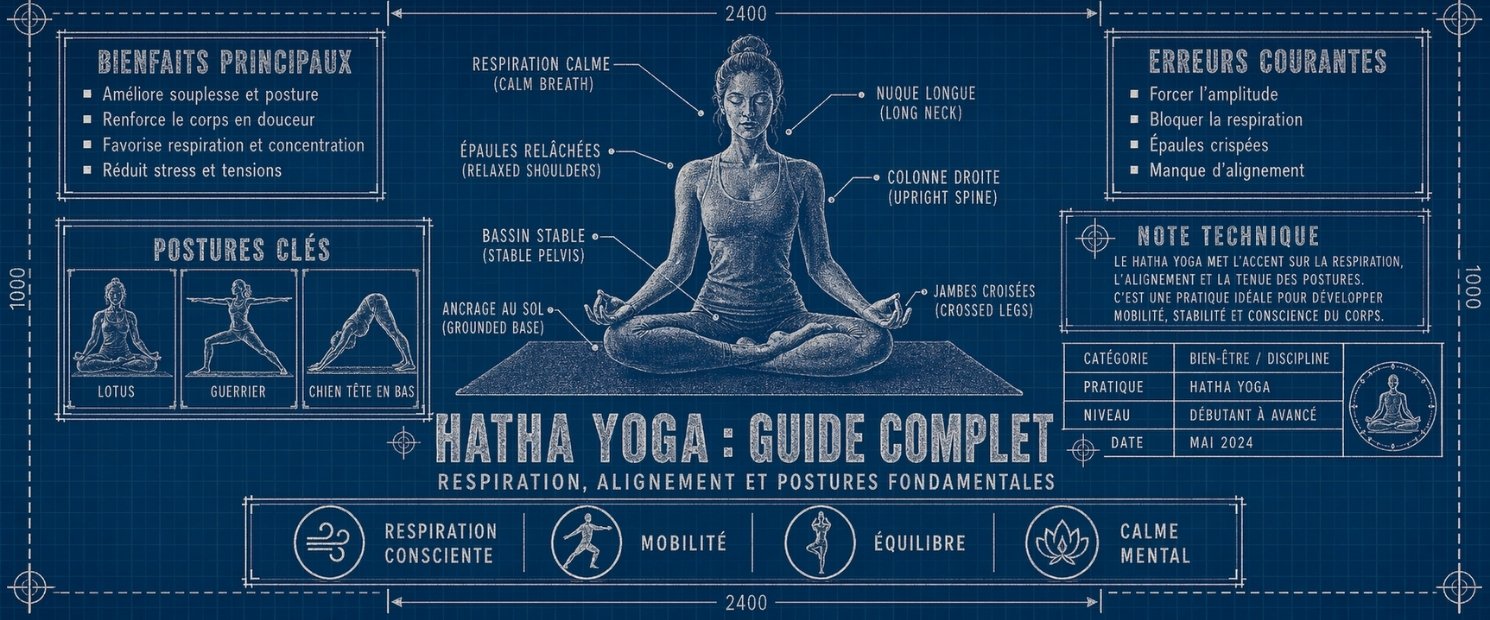
Hatha yoga: understanding a founding practice of yoga
hatha yoga occupies an essential place in the world of yoga. This is a traditional approach that emphasizes the balance between body, breath and attention. This practice is often chosen by people who want to breathe better, gain flexibility, strengthen their posture and discover a more conscious form of physical discipline.
When an Internet user types what is hatha yoga, they are generally looking for a clear, simple and reliable answer. He wants to know if this method is gentle or intense, who it is aimed at, what postures it offers and how it differs from other styles. This research intention is broad. It combines curiosity, the need for benchmarks, the desire to start and comparison with other courses.
Hatha yoga is often presented as accessible yoga. However, it should not be reduced to a slow or passive practice. Behind its apparent simplicity, it develops real postural precision, deeper breathing and better mental stability. It is precisely this alliance between structure and progressiveness that explains its lasting success.
Hatha yoga: definition, origin and philosophy
To fully understand the subject, we must go back to the source. Hatha yoga refers to a tradition that seeks to harmonize the polarities of body and mind. In the classical reading, “ha” and “tha” symbolically refer to complementary forces. Here we find a logic of unification, anchoring and alignment.
The reference text most often cited is the hatha yoga pradipika. This classic work describes the foundations of the discipline, including postures, breath work, purification and concentration. Even though modern classes have evolved, this historical basis remains useful for understanding the spirit of Hatha yoga.
In contemporary practice, Hatha yoga translates into sessions where postures are held for longer than in a rapid flow. We take the time to establish the axis of the body, observe breathing and feel the effects of each movement. This more relaxed tempo helps you progress with more control.
What is Hatha vinyasa yoga
Many people also wonder what hatha vinyasa yoga is. This research shows frequent confusion between two similar but different styles. Hatha yoga often works on posture in a more stable, more educational and more structured way. Vinyasa connects the movements in a more fluid, more rhythmic and often more cardio sequence.
In other words, Hatha lays the foundations. Vinyasa places more emphasis on circulation. The two approaches can complement each other. But they do not produce exactly the same feeling, nor the same respiratory engagement, nor the same intensity.
Hatha yoga benefits: why this practice is so attractive
Research around hatha yoga benefits is numerous, because practitioners want to know what this method can bring them on a daily basis. The benefits are physical, respiratory and mental. This is also one of the great advantages of this practice: it acts on several dimensions without requiring a sudden entry into the effort.
On a bodily level, Hatha yoga helps improve mobility, quality of posture, joint stability and deep tone. The postures strengthen the muscle chains while developing lengthening. The work is done without rushing, which promotes better body awareness.
On the respiratory level, the practice invites you to slow down. This helps to get out of high, short and nervous breathing. By learning to breathe more fully, we often improve the feeling of space in the chest, the quality of recovery and stress management.
On a mental level, Hatha yoga allows you to get back to basics. The gaze is fixed, the breath is organized and the attention stabilizes. This quality of presence is of interest to beginners as well as people already accustomed to other bodily disciplines.
The most frequently sought benefits
- improve posture and overall alignment;
- gain flexibility without forcing;
- strengthen the deep abdominal muscles and the back;
- breathe better during exercise as well as at rest;
- develop concentration and calm;
- find a regular and sustainable physical practice.
Hatha yoga for beginners: an ideal gateway
Beginner hatha yoga is often recommended for people who are discovering yoga for the first time. This choice is logical. The rhythm is generally more readable, the instructions are more detailed and the postures allow time to understand what we are doing. We are not trying to go quickly. We seek to build solid foundations.
This approach is well suited to people who need step-by-step guidance. It is also relevant for those who are returning to an activity, who lack mobility or who want to practice without pressure to perform. In this context, Hatha yoga can become a real method of learning the body.
The search for free beginner hatha yoga reflects a very concrete intention. Many want to test before registering. This is a healthy approach, provided you favor content that is well explained, progressive and focused on the fundamentals. Better a short, clear session than an overly complex course followed without guidance.
Hatha yoga beginning a gentle discovery
The formula hatha yoga beginning a gentle discovery perfectly sums up the spirit of this practice. Hatha yoga does not seek to impress. He seeks to establish a right relationship with movement, breath and attention. This progressiveness is reassuring. It also allows you to better feel the effects of regular practice.
beginner hatha yoga session
A beginner hatha yoga session often includes a breathing start, a few simple mobilizations, basic postures held for a few breaths, then a return to calm. The point is to work without dispersion. We learn to place the feet, open the rib cage, lengthen the spine and not confuse speed and efficiency.
For many beginners, this format is more reassuring than a very fluid course. It leaves space to correct, feel and understand. This progressive pedagogy is one of the great strengths of Hatha yoga.
hatha yoga youtube beginner
If you are looking for hatha yoga youtube beginner, the goal is often to practice from home. This is a good option for discovering the discipline, provided you choose readable content, with simple instructions and a really suitable level. The ideal is to start with short sessions, then gradually increase the duration.
beginner hatha yoga book
The keyword beginner hatha yoga book reveals another expectation: understanding the practice beyond the simple course. A good introductory book can help you better understand the logic of postures, breathing, vocabulary and common errors. It also provides a reassuring framework for practicing more methodically.
Hatha yoga postures: which positions are found most often?
Research around hatha yoga postures is central, because most Internet users want to know what a session actually looks like. Hatha yoga is based on a set of positions held with attention. Each posture aims for a specific effect: alignment, stability, opening, anchoring, strengthening or relaxation.
The hatha yoga postures are generally accessible. They learn to stand with more balance, to position themselves better on the ground, to strengthen the center of the body and to calm the nervous system. Even simple postures become very instructive when practiced with precision.
hatha yoga position: the basics to know
The search for hatha yoga position often refers to a desire for a clear list. In a beginner or intermediate practice, we often find mountain pose, downward facing dog, pincers, cobra, warrior, child's pose, bridge and certain gentle twists. These positions allow you to work the entire body without rushing.
Examples of commonly used postures
- the mountain for anchoring and alignment;
- child’s posture for relaxation;
- downward facing dog for lengthening;
- the cobra for opening the bust;
- warriors for stability and strength;
- the forceps for stretching the posterior chain;
- the bridge for mobility of the pelvis and back;
- twists for spinal mobility and breathing.
hatha yoga postures pdf
Many users are looking for hatha yoga postures pdf to have practical support to consult offline. This intention shows that they want to memorize postures, structure their practice or build a simple routine. In a good support, you must find the name of the postures, their objective, the precautions and possible adaptations.
hatha yoga postures images
The search for hatha yoga postures images meets a visual need. Images can help you understand a general form, but they are not always enough to practice well. Correct posture is not just about appearance. It also depends on breathing, support, the direction of the pelvis and the relaxation of unnecessary areas.
Hatha yoga exercises: how to organize a concrete practice
The keyword hatha yoga exercises shows that many Internet users are looking for practical content, not just theoretical. A Hatha yoga class is based on a logical progression. We often start by centering ourselves. Then come mobility exercises, then standing postures, on the ground, openings, simple balances or extensions, before a return to calm phase.
Hatha yoga is therefore not an accumulation of isolated positions. It is a progressive organization of the body and the breath. Each sequence has a logic. We prepare, we install, we hold, then we release.
hatha yoga breathing exercises
Research hatha yoga breathing exercises is essential, because breathing is part of the heart of the practice. In a Hatha yoga class, you learn to breathe more fully and consciously. We often try to lengthen the inspiration, stabilize the exhalation and synchronize the breath with the movement.
These exercises can take the form of abdominal breathing, work on lengthening the breath, alternate breathing or a simple respiratory presence exercise. The objective is not performance. The objective is regularity, quality of attention and progressive mastery of the internal rhythm.
Breathing exercises frequently associated with Hatha yoga
- slow, deep breathing while sitting;
- observation of the breath without forced modification;
- progressive lengthening of expiration;
- alternate breathing in a more advanced practice;
- breath-movement coordination during postures.
Sun salutation and progressive body work
The hatha yoga sun salutation for beginners interests many practitioners, because it represents an emblematic sequence. In Hatha yoga, this sequence can be practiced in a slower and more educational manner than in other styles. Each step is laid out. Transitions are clarified. We seek less spectacular fluidity than awareness of placement.
For a beginner, the sun salutation is often used to mobilize the body, warm up the joints, coordinate breathing and movement, then establish a rhythm of practice. Well guided, it becomes a very complete tool.
Dynamic hatha yoga: is there a more tonic version?
Yes, dynamic hatha yoga exists. This is an approach that retains the basics of Hatha yoga, but with a more sustained tempo, more present sequences and sometimes more tonic work on the supports and core. This remains different from a very fluid Vinyasa, but the intensity can be more marked than in traditional Hatha.
This nuance is important. Hatha yoga is not always fixed or very slow. Depending on the teacher, the level of the group and the objective of the class, it can become more physically engaging, while maintaining a real quality of precision and breathing.
Hatha yoga vs vinyasa: what are the concrete differences?
The comparison hatha yoga vs vinyasa comes up very often. This is normal, because many hesitate between these two practices. Hatha yoga generally offers a calmer pace, more detailed work on postures and a reassuring setting for learning. Vinyasa is characterized instead by more fluid transitions, respiratory continuity in the movement and a more dynamic sensation.
The question is not just which style is “better”. Above all, you need to ask yourself what you are looking for: progressive learning, intensity, fluidity, strengthening, mobility or active relaxation.
hatha yoga vs vinyasa flow
The query hatha yoga vs vinyasa flow precisely reflects this hesitation. Vinyasa Flow emphasizes the sequence. Hatha yoga places more emphasis on installation. In a Hatha class, you can breathe longer in one posture. In a Vinyasa class, you can feel more continuous circulation and more present cardiovascular effort.
hatha yoga or vinyasa
If you are wondering hatha yoga or vinyasa, the answer depends on your profile. Hatha is often best suited to beginners, people who want to understand the basics, and those looking for a more relaxed pace. Vinyasa appeals more to people who like continuous movement, variety and more fluid sessions.
hatha yoga vs vinyasa reddit
Many Internet users type hatha yoga vs vinyasa reddit to read feedback. This research shows that they want real opinions. It is useful for planning ahead, but it does not replace personal testing. Two people can experience the same class very differently depending on their level, their energy and their relationship to effort.
hatha vs vinyasa and yin yoga
The comparison hatha vs vinyasa and yin yoga is very relevant, because these three styles meet different needs. Hatha works on alignment and stability. Vinyasa promotes movement and fluidity. Yin yoga focuses on long, often passive postures, with a deeper objective of tissue relaxation and slowness.
hatha yoga vs vinyasa vs ashtanga
When we look for hatha yoga vs vinyasa vs ashtanga, we are actually comparing three intensities and three educational frameworks. Hatha remains the most accessible for learning the basics. Vinyasa is more fluid and freer in the construction of the classes. Ashtanga is based on a codified series, more physically demanding and more repetitive in its structure.
Hatha yoga Paris: how to choose a good class
The search hatha yoga paris refers to a local intention. The user is no longer just looking for a definition. He wants a place, a teacher or a studio. In this case, the right choice criteria remain simple: level of the course, educational clarity, atmosphere, accessibility of the place, quality of the instructions and adaptation to beginners.
In Paris as elsewhere, it is useful to check if the course is truly beginner-oriented, if it includes breathing work, and if it allows time to correct postures. A good Hatha yoga class should allow you to understand what you are doing, not just to follow the group.
What to look for before booking
- the announced level of the course;
- the duration of the session;
- the place given to breathing;
- the exact style of the professor;
- the possibility of adapting postures;
- the general atmosphere of the studio.
Hatha yoga basic postures: a useful progression for everyone
The hatha yoga postures are not just for beginners. They are also useful for more advanced practitioners who want to get back to basics. A solid practice is always based on well-integrated foundations: active feet, positioned pelvis, long spine, available shoulders and regular breathing.
This logic explains why Hatha yoga maintains a central place in so many schools. It’s not just “easy” yoga. This is a yoga that teaches. And this is precisely what many people look for before exploring more dynamic styles.
Build a simple Hatha yoga routine at home
To practice regularly, it is not necessary to do a long session each time. A simple routine can already produce very positive effects. A few minutes of breathing, a few standing postures, opening the back, gentle bending and quiet time are enough to create a stable base.
Regularity is often more important than duration. A twenty-minute practice, well constructed and repeated several times a week, often provides more than a very long lesson carried out irregularly.
Simple routine to consider
- two to three minutes of calm breathing;
- gentle joint start-up;
- a slow sun salutation;
- two or three standing postures;
- a gentle extension posture;
- a seated or lying posture to return to calm.
Conclusion: why Hatha yoga remains a reference
Hatha yoga remains a major practice because it meets very varied expectations. It helps to get started. It allows you to better understand postures. It improves breathing. It offers a real quality of presence. It also constitutes a solid basis for exploring other styles.
Whether you are looking for hatha yoga postures, hatha yoga exercises, hatha yoga benefits or a hatha yoga paris class, you always come back to the same idea: a structured, readable and sustainable practice. It is precisely this coherence that makes Hatha yoga a pillar of both modern and traditional yoga.
You might also like