You've been training for months, but your arms won't budge? It happens to almost everyone in the gym. The arm is a small muscle, and it already works on every row and every press. Growing it takes a clear plan, not a pile of curls. This arm workout program gives you the exercises, the number of sets, the reps and the pace to hold. You'll find a home session, a dumbbell session and a progression built for beginners. Every piece of advice stays simple to apply, whether you're a man or a woman.
Know your arm muscles before you train them
A good training program always starts with anatomy. The arm muscles fall into three groups: biceps, triceps and forearms. Each one has a specific job. Each one responds to a different kind of work. Knowing these basics saves you from wasting time on badly chosen exercises.
The biceps, smaller than it looks
The biceps bends the elbow and rotates the forearm. It has a long head and a short head. The long head sits on the outside of the arm: that's the one that gives you the peak. It works best when the arms sit slightly behind the body, as in an incline curl. The short head, on the inside, responds well to wide-grip curls. This muscle likes moderate loads and time under tension. No need to go too heavy: the shoulders take over, and the arm gets nothing.
The triceps, where the size really comes from
Plenty of lifters want big arms and think only about curls. That's a mistake. The triceps makes up close to two thirds of the arm's volume. It splits into three heads: long, lateral and medial. The long head attaches to the shoulder blade. It only stretches fully when the arm goes overhead. That's exactly why overhead extensions stay essential to build your triceps along their full length.
The rules of an arm program that actually works
Sets, reps and loads: the numbers that matter
Aim for 6 to 10 sets per muscle per week if you're starting out, up to 15 if you're advanced. On each exercise, do 3 to 4 sets of 8 to 12 reps. Isolation moves handle longer sets well, up to 15 reps. Leave 1 to 2 reps in reserve, except on the last set. Rest 60 to 90 seconds between sets. Add load or add reps as soon as a set feels easy: that's progressive overload, the only real driver of progress.
How often to schedule an arm session
Two shorter hits per week beat one big session. Your arms already work during a back or chest day. So count that indirect work in your total volume. A dedicated arm session rarely runs longer than 40 minutes. Put it away from your heavy compound days, ideally 48 hours after. Rest is part of the plan: the muscle rebuilds during recovery.
Beginner arm workout program: your first session
Start simple. Three exercises are enough for the first few weeks. The goal isn't fatigue, it's technique and consistency.
 Biceps: EZ-bar curl, 3 sets of 10 reps. Grip the bar at shoulder width, elbows pinned to your sides.
 Overhead triceps extension, where the triceps works through its full length: seated on a bench, one dumbbell held in both hands behind your head, 3 sets of 12.
 Hammer curl, 3 sets of 12 reps per arm, for the forearm and the brachialis.
Stick with this program for four weeks. Write down your loads at every session, in a notebook or a PDF you keep on your phone. You need those numbers next time to know what to beat. This habit is what separates people who progress from people who go in circles.
What's the most effective arm exercise?
No single exercise does everything. But if you had to keep one per muscle, take the barbell curl for the biceps and the close-grip bench press for the triceps. The first lets you load up without losing your torso position. The second combines load and range of motion. Lying on a bench, hands about a foot apart, lower the bar to the bottom of your chest with your elbows close to your body. Then press to full lockout. That close grip shifts the work from the chest to the back of the arm.
Right behind them come cable pushdowns (with a rope or a straight bar). Focus on the squeeze at the end of the movement, elbows fixed against your sides. The skull crusher is another brutal classic for the long head. Lying down, lower the bar toward your forehead, then press back up without moving your shoulders. Stay strict: this one doesn't forgive momentum.
Home arm workout program, no equipment
No gym, no weights? You can still make progress. A bodyweight arm workout program runs on your own weight and on well-chosen surfaces. It comes down to two things: slow the movement down and use the full range.
 Close-grip push-ups, hands under your shoulders: 4 sets to the max number of clean reps.
- Dips between two chairs or off the edge of a couch: 3 sets of 12.
 Decline push-ups, feet elevated: 3 sets of 10, to add resistance.
 Curls with a backpack loaded with books or water bottles: 3 sets of 15.
- Chin-ups on a doorway bar: 4 sets to the max, if you own one.
A resistance band changes everything at home. It costs almost nothing, stores anywhere, and handles curls just as well as overhead extensions. Use a slow tempo: three seconds down, one second up. The muscle doesn't count kilos, it counts the tension it's under.
Gym arm workout program with dumbbells and barbell
In the gym, the range of angles is what makes the difference. Here's a full session to run twice a week, switching the exercise order from one session to the next.
 Close-grip bench press: 4 sets of 8 reps.
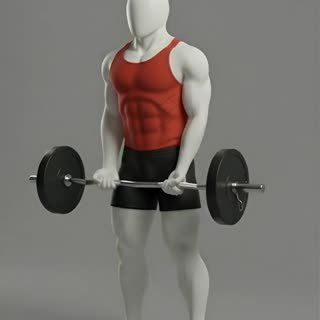 EZ-bar curl: 4 sets of 10.
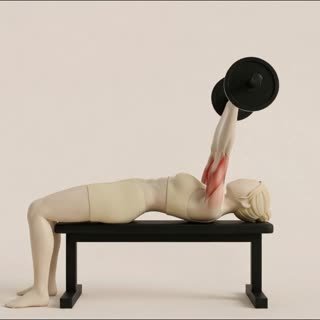 Skull crusher on a flat bench: 3 sets of 10.
- Incline dumbbell curl, bench set to 45 degrees: 3 sets of 12.
- Cable pushdown: 3 sets of 15.
- Hammer curl: 3 sets of 12.
This dumbbell arm workout program alternates a triceps exercise with a biceps exercise. That setup, called an antagonist superset, saves time. While the biceps works, the triceps recovers. Always finish on the cable: tension stays constant through the whole range, which gives you a solid pump to end on.
Arm workout program for women: same exercises, different goals
Women train with the same movements as men. Muscle physiology doesn't change. Many worry about getting bulky arms, but that fear has no basis: testosterone levels make gaining size very slow. An arm workout program for women usually targets firm, defined arms, especially the back of the arm. Cable pushdowns, dips and push-ups fit that goal perfectly. At home, a band and two light dumbbells are enough to get going.
Arm workout program for men: going for size
For men, the request is usually bigger arms. The main lever is load. A size-focused arm workout program for men keeps 6 to 8 reps on the compound exercises, then moves up to 12 or 15 on isolation. What's on your plate counts as much as what's on the bar: without a slight calorie surplus and enough protein, your body has nothing to build with.
The mistakes that stall your progress
- Too many sets: past twenty sets a week, the arm stops recovering.
- Too much weight: your back arches, your elbows flare, and the target muscle stops doing the work.
- Partial range: a half-rep curl leaves part of the fibres idle.
- Floating elbows: keep the elbows fixed and you actually isolate the muscle you're after.
- No tracking: without a log, you can't tell whether you're moving forward or standing still.
Evolving the program week after week
A plan doesn't stay untouched for six months. Run a four-to-six-week cycle, then change one variable. You can add a set, add 2.5% to the load, slow the lowering phase, or swap an exercise for a close variation. Go from a barbell curl to a low-cable curl, for example. The movement stays the same, the tension moves.
Also plan an easier week every two months. Cut the volume in half and keep the same loads. Your elbows will appreciate the break, and you often come back stronger. Finally, keep an eye on sleep and protein intake, around 1.6 grams per kilo of bodyweight per day. Without those two pillars, no training program gives you its best.
Common questions about arm training
How long before I see results?
Count on eight to twelve weeks for a visible change, with two sessions a week and decent nutrition. Arm circumference gains one to two centimetres a year on average for a consistent lifter. Patience is part of the job.
Should I train arms every day?
No. Muscle needs 48 hours to repair. Daily work blocks that rebuild and raises your risk of elbow tendinitis.
Can I train biceps and triceps on the same day?
Yes, and it's the most practical setup. Between biceps, triceps and forearms, a 40-minute session is plenty. You can also split it differently: biceps with back, triceps with chest.
Can you really progress with no equipment?
Yes, especially at the start. Push-ups and dips load the triceps well. The biceps, though, eventually runs short on resistance: a band or two dumbbells become useful after a few months.
One arm bigger than the other, what now?
Always start with the weaker side on unilateral exercises. Then match the strong side to the same number of reps, even if it could do more.
Getting help to go further
A written plan beats an improvised session. A personal trainer adjusts your volume, fixes your technique and adapts the exercises to your equipment and your schedule. On Koatcher, you can compare trainers near you or online, then start personalised coaching. To go further, read our guide to building mass and our advice on protein.