Your calves are usually the poor relation of a training session. They get pushed to the end of the workout, the last sets get rushed, and then people wonder why the size never comes. Yet the calf raise is still the simplest exercise for moving the lower leg forward. You will sometimes see the terms « calf extensions » or « heel raises » on exercise sheets: it is the same movement. This guide walks step by step through standing and seated technique, which muscles are worked, and how to vary the stimulus.
Which muscles do calf raises work?
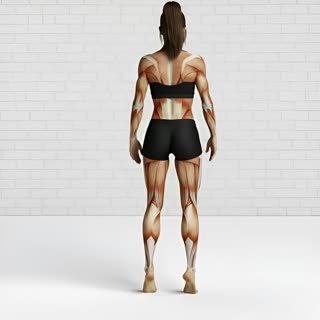
The lower leg is built around a group called the triceps surae. Three muscle heads make it up: two for the gastrocnemius, one for the soleus. All of them feed into the Achilles tendon. Knowing this trio helps you pick the right working angle.
The gastrocnemius, the visible part
The gastrocnemius forms the two « twin heads » you can see below the knee. It has a medial head and a lateral head. Because it crosses the knee joint, it is under tension mainly when the leg is straight. So it is the standing raise, knee straight, that stimulates it best.
The soleus, the endurance engine
The soleus hides underneath the twin heads. It sits deeper, it is thicker and packed with slow-twitch fibers. It does not cross the knee. As soon as you bend your legs, it becomes the main working muscle. It will let you hold up over the distance when running or cycling. As it thickens, it also pushes the twin heads outward and widens the shape of the calf.
The Achilles tendon, the drive belt
This tendon links the triceps surae to the heel. It absorbs several times your body weight on every stride. Loading it progressively makes it stronger and limits the risk of tendinopathy. A controlled negative phase is still its best protection.
Standing calf raise: the reference technique
The standing calf raise is the base movement. You can do it on a machine, in a Smith machine, with dumbbells, or with body weight on a step.
Finding your starting position
Put the balls of your feet on the edge of a step or a footplate. Your heels hang free. Set your stance as wide as your hips. Straighten your knees without locking them. Keep your torso upright and your eyes forward. One hand on a support is enough to stay balanced. This starting position sets up the whole set.
Up, hold, down
Rise as high as possible by pushing through your toes. This movement has a precise name: plantar flexion. Hold for one second at the top point, calves squeezed hard. Then lower your heels slowly, until you feel a clear stretch through the lower leg. That gives you a full range of motion. Drive back up to return to the top position, with no bounce. Two seconds on the way down beat a short, jerky movement.
Standing calf raise variations
 Calf raise machine: shoulders wedged under the pads, the load stays perfectly stable.
- Smith machine calf raise: the guided bar secures the path and lets you go heavy.
 Standing dumbbell calf raises: one dumbbell in one hand, one leg at a time, and with the other hand hold onto an upright.
- Calf raise on a step: body weight only, perfect at home or as a warm-up.
Seated calf raise: the key to the soleus

Mollets assisMollets · machines
The seated calf raise changes everything. With the knees bent to 90 degrees, the gastrocnemius goes slack. The soleus takes over and works harder. Alternating the two positions is still the best way to train your calves across their whole surface.
Thigh and foot placement
Sit down, then slide the pads onto your lower thighs, close to the knees. The balls of your feet rest on the platform, heels free. Release the safety catch. Lower your heels toward the floor, then push upward with a hard contraction. Your back stays against the pad, with no jerk from the hips.
Reps, tempo and endurance
The soleus responds well to long sets. Aim for 15 to 25 reps over 3 or 4 sets. For the standing version, 10 to 15 reps with a heavier load give better results. Alternating the two builds both strong calves and real endurance. Runners, soccer players and cyclists gain a lot from it.
Calf raise on the leg press: an effective compromise

FenteJambes
The leg press calf raise is done on the leg press machine. Put the balls of your feet low on the platform, legs almost straight. Push the platform with your toes, without bending the knees. The upside is obvious: your spine takes no compression. It is a good option if loaded standing calf raises bother your back.
Turning your feet in or out
Rotating your feet changes how the work is shared. Toes turned in, the lateral head takes more. Toes turned out, the medial head does more. Feet parallel, the load is split. Switch the orientation from one week to the next: that small detail is enough to wake up your calf muscles again.
The mistakes that stall progress
- Going too heavy and cutting the range of motion down to a couple of inches.
- Bouncing off the tendon instead of controlling the way down.
- Bending the knees during a standing raise, which shifts the effort elsewhere.
- Never switching versions: the gastrocnemius and soleus need different angles.
 Skipping the stretches after training, when the triceps surae shortens fast.
Building your calf raise routine
Two or three sessions a week are enough. Pair a standing version with a seated version in the same block. Add 2.5 kg as soon as every rep goes up cleanly. Write your loads down: progress here plays out over months, not weeks. Even a rough logbook beats memory, because the load jumps are small on this exercise. For a plan suited to your build, a personal trainer can adjust volume and tempo. You can also browse our strength training guides to round out your lower body.
Warm up before, stretch after
Start with 20 slow raises at body weight, feet flat on the floor. The Achilles tendon loosens up and the first set goes down better. After the session, hold a stretch for 30 seconds per leg, back leg straight and then slightly bent. That way you target the two muscles one after the other. This habit protects the ankle and keeps your range of motion over the long term.