The decline bench press holds a place of its own in a chest session. On a bench angled downward, the position changes how the effort is spread out and shifts the load toward the lower fibers of the pectoralis major. Plenty of lifters discover it after months of standard flat bench work, and immediately feel a new kind of tension under the chest. Provided, of course, that they know how to set the bench up and anchor themselves properly.
Decline bench press: which muscles are worked?
The decline angle hits the lower chest first, with help from the triceps brachii and the front deltoid. The clavicular head stays fairly quiet: that is what the incline press is for. This split explains why the exercise mainly serves to build thickness and sharpen the lower line of the muscle.
How many muscle fibers you recruit depends directly on the angle you choose. A 15 to 30 degree decline is plenty. Go steeper and the blood rushing to your head turns unpleasant while the benefit-to-risk ratio gets worse. Nothing stops you from changing that angle from one week to the next to vary the feel.
How to do the decline bench press with a barbell
Setting up your starting position
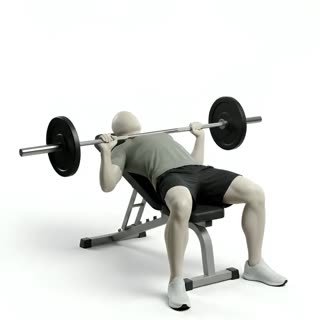
Get into the lying position, legs tucked under the roller pads. The feet stay firmly anchored, the hips stable, the rib cage open and the shoulder blades pulled together. Then place your hands on the bar, slightly wider than shoulder width, wrists stacked in line with the forearms.
Executing the movement
Unrack the bar and bring it over the lower part of your chest. Lower it slowly until it grazes the sternum, elbows at roughly 45 degrees to the torso rather than flared straight out to the sides. Press up without snapping the arms into lockout: the bar finishes its path above the pecs, never above your face.
Breathing follows the movement — inhale on the way down, exhale as you press. Make sure you keep control through the whole range: a three-second controlled descent gives you more than a heavy load dropped in free fall. It is also what lets you hold your strength through to the last rep.
Dumbbell decline press: more range, more demand
With two dumbbells, each arm works alone and fixes its own imbalances. The hands can travel lower than a barbell allows, which stretches the pec further at the bottom. The movement does demand constant shoulder stabilization in return.
Getting set up is the tricky part. Rest the dumbbells on your thighs, kick them back as you lie down, then perform the first press once you are in position. A partner or a coach makes this phase far easier.
Smith machine, guided machines and cables
When using a Smith machine, the rails dictate the bar path. A beginner lifter gains safety and can focus on the contraction. The decline press on a converging machine plays the same role, with a seat adjustment standing in for the bench.
Low cables also make for a worthwhile variation: tension stays constant from start to finish, where the barbell has a dead spot at the top of the rep.
Decline, incline or flat: how to combine them
 Flat bench press: the foundation, first up in the session.
 Incline barbell press or incline Smith machine press: for the upper chest, which often lags behind.
- Decline bench press: two or three sets at the end of the session are enough over the long run.
Common mistakes and injury risk
 Bouncing the bar off the sternum, a source of pain and joint risk.
- Skipping the spotter: on a decline bench, sitting back up alone with a heavy load is a problem.
- Adding weight too fast at the expense of a full range of motion.
Frequently asked questions about the decline bench press
Is the decline bench press easier?
Often, yes: the range is shorter and the loads handled go beyond what you move on the flat bench. That is no reason to let technique slide.
Decline bench press: what do people in the gym think?
Opinions are split. Some coaches call it redundant with the flat bench press, others value how it isolates the lower portion without overloading the shoulder. In practice, it helps most the lifters who barely feel their chest on standard horizontal movements, or whose shoulders complain and who find the decline position less aggressive.
Should it be in every session?
No. Once a week is enough for most people. A strength training coach will adjust the volume to your build and your goals.