A pair of dumbbells, a couple of square meters and a bit of method: that is all you need to make progress. Dumbbell training is still one of the most effective ways to build muscle at home or in the gym. In this guide you will find a complete training plan, the dumbbell exercises worth knowing, and concrete benchmarks for targeting every muscle group without getting hurt.
Why dumbbell training works so well
Dumbbells free up movement. Unlike guided machines, they force your body to stabilize the load at every moment. The deep muscles work non-stop, even on a simple exercise. That stabilizing work improves coordination. It also corrects left-to-right imbalances, which are very common in beginners.
Two dumbbells, hundreds of exercises
You can build an entire plan with two dumbbells. Press, row, curl, lunge, Romanian deadlift: there are hundreds of exercises you can do with a single pair. That means you can train your upper and lower body without ever switching equipment. For someone just starting out, it is an excellent place to begin.
A lower risk of injury
A barbell locks you into a fixed path. Dumbbells adapt to your build. Shoulders, elbows and wrists follow their natural line. The risk of injury drops noticeably, especially on pressing movements. And if a load becomes too heavy, you simply drop it to your sides. That safety margin changes everything when you train alone.
A complete dumbbell workout plan: the structure
Full body, upper/lower or split
Three formats dominate. Full body hits every muscle group in each session: perfect if you train two or three times a week. Upper/lower separates the top and bottom of the body across four sessions. The split isolates specific groups and needs five slots a week. Choose based on the time you actually have, not on what the person on the next mat is doing.
Sets, reps and rest periods
To build muscle mass, aim for 3 to 4 sets of 8 to 12 reps. To build strength, drop to 5 or 6 reps with heavier weights. Rest follows the same logic: 60 to 90 seconds for hypertrophy, 2 to 3 minutes for strength. Use a notebook to log your loads. It is the simplest way to check that you are genuinely progressing.
The best dumbbell exercises, group by group
Here are the movements to include first in a dumbbell workout plan. The exercises listed below cover the whole body and can be done almost anywhere.
Upper body
 Bench press: chest, triceps and front delts.
- Bent-over row: back, biceps and rear delts.
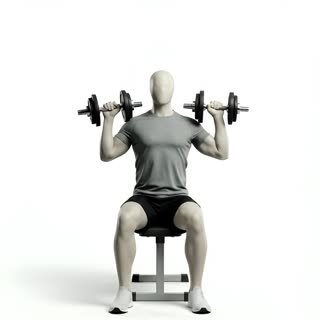 Seated overhead press: deltoids and upper back.
 Hammer curl: biceps and forearms.
 Overhead triceps extension: triceps.
Lower body
 Dumbbell squat (or goblet squat): quads and glutes.
 Walking lunges: balance, glutes and hamstrings.
 Romanian deadlift: the entire posterior chain.
 Step-up: single-leg power.
 Standing calf raise: gastrocnemius and soleus.
Core and midsection
Finish each session with five minutes of core work. Renegade rows, Russian twists and weighted crunches are more than enough. Add them at the end, never before the heavy lifts: a tired trunk protects the spine far less well.
A sample week
This plan suits an intermediate lifter with three slots a week. Run the sessions below in order. Vary the exercises to give each muscle time to recover between sessions.
- Monday, session A: dumbbell squat, bench press, row, hammer curl, core work.
- Wednesday, session B: Romanian deadlift, overhead press, lunges, triceps extension, abs.
- Friday, session C: goblet squat, single-arm row, incline press, calves, side plank.
Leave at least 48 hours between two sessions that work the same muscles. A plan only works if you respect recovery.
Adapting the plan to your goal
Building muscle and adding size
If you want to add size, increase the load as soon as you get past 12 clean reps. Give your body enough protein, roughly 1.6 grams per kilo of bodyweight. A mass-gain goal also demands sleep: muscle rebuilds at night.
Losing weight and getting fitter
To lose weight, run the exercises as a circuit with only 30 seconds of rest. Energy expenditure climbs and your fitness improves fast. Resistance work also helps improve body composition: you keep muscle while you lose fat. Two lifting sessions plus one cardio outing already deliver excellent results.
Frequently asked questions
Where can I find a dumbbell workout plan pdf?
Plenty of people want something they can print, so they type “dumbbell workout plan pdf” into Google. A fixed document has one major flaw, though: it knows nothing about your level, your equipment or any pain you are dealing with. A personal plan, adjusted every six weeks, works far better than a dumbbell workout plan downloaded at random.
Which pair of dumbbells should I buy?
Go for adjustable dumbbells. A range of 2 to 20 kg per arm covers most people for a good two years. Fixed models get expensive fast once you start progressing.
Do I still need a gym?
Not necessarily. An adjustable bench and a pair of dumbbells reproduce the vast majority of the different movements you would do in a standard gym. A gym still earns its place for very heavy loads and for hands-on coaching.
How long before I see results?
The first sensations show up within three weeks. Visible changes take two to three months of consistent training.
Ratings and reviews: what lifters actually say
The feedback is remarkably consistent. Beginners like the simplicity: no queue, no commute, a session done in 45 minutes. Experienced lifters mostly mention better shoulder stability after a few months. The complaint always lands on the same point: the top-end load, which runs out quickly on squats and deadlifts. The workaround is to slow the tempo down and add reps.
One last piece of advice. Get your technique checked by a professional. A coach spots in one session what a video will never show you. Find a personal trainer near you or browse our other training plans to vary the stimulus.